
Why Is My AC Not Cooling? Common HVAC Problems in Edmond OK Homes
There's a particular kind of frustration that comes with an air conditioner that's running but not actually cooling. The system kicks on. You hear it humming. The air is moving. But your home keeps climbing toward 85 degrees while your energy meter spins and your patience disappears. You've done everything right, changed the filter recently, kept the vents clear, and yet here you are, sweating through what should be a comfortable afternoon.
In Edmond OK, where summer temperatures routinely push into the upper 90s and triple digits aren't unusual, an AC that runs without cooling isn't just uncomfortable. It's a genuine quality-of-life crisis. And it's a problem that escalates quickly: the longer an underlying HVAC issue goes unaddressed, the more stress accumulates on system components, and the more a manageable repair can develop into a much more expensive one.
This guide covers the seven most common reasons your AC stops cooling effectively in Edmond OK homes, what each problem actually means for your system, which situations you can address yourself, and when calling a qualified HVAC Edmond OK professional like A&T Mechanical Heat&Air Services, Inc. is the right and necessary move.
When Your AC Runs But Your Home Stays Warm
Before diving into the specific causes, it's worth understanding why a running air conditioner can fail to cool. It's a distinction that often confuses homeowners because the instinct is to assume that if the system is on, it must be working.
The Difference Between an AC That Won't Start and One That Won't Cool
An air conditioner that won't start at all has a different problem profile than one that runs but fails to cool. A system that won't start typically points to electrical issues: a tripped breaker, a blown fuse, a failed capacitor, or a thermostat problem. These are often relatively straightforward to diagnose and address.
An AC that runs but doesn't cool is a more nuanced situation. It means the mechanical operation of the system is partially functioning, but something is preventing the heat transfer process from working correctly. This could be an airflow problem, a refrigerant issue, a coil problem, a dirty outdoor unit, or a ductwork failure. Identifying which of these is responsible requires systematic diagnosis rather than guesswork.
Why Edmond OK's Summer Heat Makes This Problem Urgent
Standard HVAC design guidelines size systems to maintain indoor comfort when outdoor temperatures reach a defined design temperature. In Edmond OK, that design temperature is typically in the range of 99 to 102 degrees Fahrenheit. When outdoor temps push into the upper 90s and beyond during Oklahoma's hottest weeks, your AC system is operating at or near its maximum designed capacity even when it's functioning perfectly.
This means that any problem limiting your system's efficiency, even a partial restriction or moderate refrigerant shortage, gets amplified dramatically during extreme heat. A system that barely keeps up under normal summer conditions may fail entirely to maintain comfortable temperatures during a heat wave. This is why HVAC Edmond OK issues that seem mild in spring can become urgent emergencies by July.
Problem #1: A Dirty or Clogged Air Filter
This is the most common cause of reduced cooling performance, and also the most preventable. It's the first thing any competent HVAC technician checks, and it's the first thing you should check, too.
How a Neglected Filter Suffocates Your Entire System
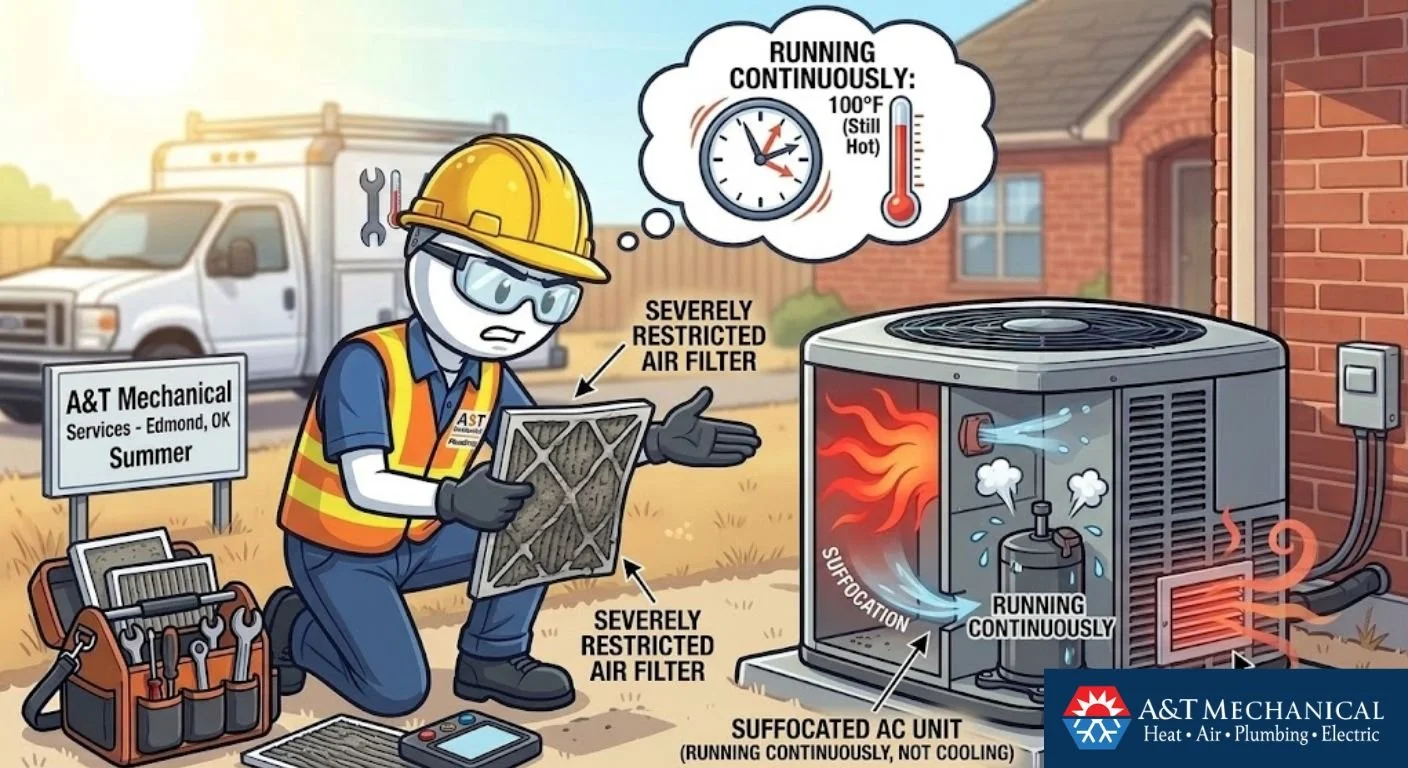
Your air filter's job is to catch airborne particles before they enter your HVAC system. But a filter that's been in place for too long becomes a dense mat of accumulated dust, debris, pet dander, and pollen. At that point, it stops being a filter and starts being a wall, restricting the airflow your system depends on to function.
Think of your AC system as a person trying to breathe through a thick scarf. The harder they breathe, the less air actually gets through, and the more exhausted they become. Your AC is the same way. Restricted airflow causes the evaporator coil to run colder than designed, which leads to ice formation, reduced heat transfer, and a system that's working harder to do less. Energy bills rise, cooling performance drops, and system components wear prematurely because they're operating under constant stress.
A severely restricted filter is capable of causing a complete loss of cooling capacity, turning a system that should be running at full efficiency into one that barely moves conditioned air through your home.
How Often Edmond OK Homeowners Should Change Their Filters
Standard guidance says every 60 to 90 days for a 1-inch filter, but Edmond OK, conditions often warrant more frequent changes. Homes with pets, residents with allergies, or significant dust exposure from construction or landscaping activity may need monthly filter changes during the peak cooling season. If you're running your system heavily during an Oklahoma summer, check the filter every 30 days and replace it when it shows visible graying or when you can no longer see light through it when held up.
Higher MERV-rated filters catch more particles but also restrict airflow more aggressively. Make sure the filter rating is appropriate for your specific system, since some units aren't designed for very high MERV filters. Your HVAC Edmond OK technician can confirm the right filter specification for your equipment.
Problem #2: Low or Leaking Refrigerant
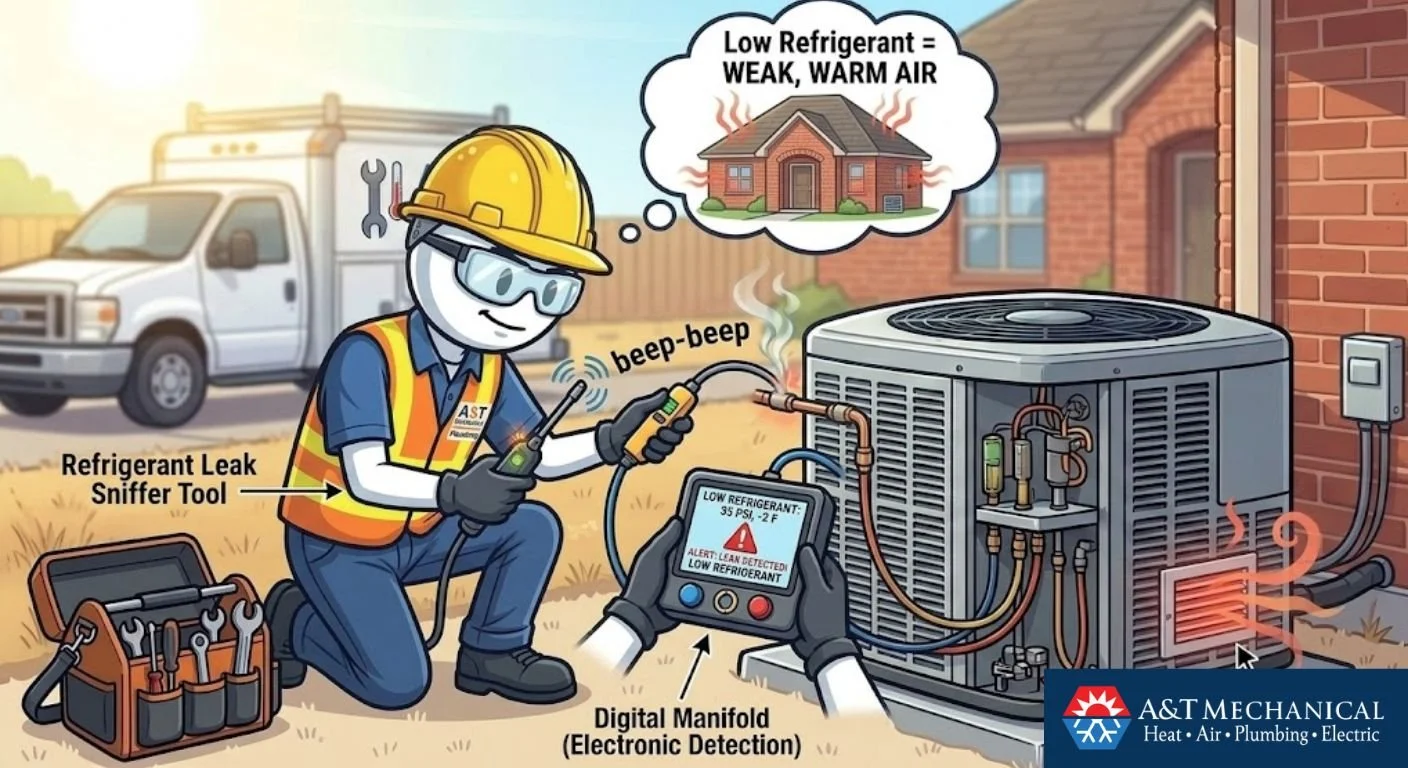
Refrigerant is the lifeblood of your cooling system. Without the right amount of it circulating at the right pressure, your AC cannot perform its fundamental function: removing heat from inside your home.
What Refrigerant Actually Does and Why It Matters
Refrigerant is the working fluid that carries heat from inside your home to the outside. It cycles between liquid and gas states, absorbing heat from the indoor air at the evaporator coil and releasing that heat outside at the condenser coil. The amount of refrigerant in the system, its pressure, and its temperature at various points in the cycle are precisely calibrated for your specific equipment.
A common misconception is that refrigerant gets "used up" like fuel and needs to be periodically topped off. It doesn't. A properly functioning, leak-free system retains its refrigerant charge indefinitely. When refrigerant levels are low, it always means there's a leak somewhere in the system, not that the refrigerant was consumed. Adding refrigerant without finding and repairing the leak is a temporary measure that delays the problem rather than solving it.
Signs That Your System Is Low on Refrigerant
Low refrigerant produces several recognizable symptoms. The most common is weak or warm air from your supply registers, even when the system is running. You may notice that the air feels humid rather than crisp and dry, because adequate refrigerant is essential for dehumidification. The indoor unit's evaporator coil may ice over (more on that shortly). You might hear a hissing or bubbling sound near the refrigerant lines, which indicates refrigerant escaping through a leak point. And your system may run continuously without ever achieving the thermostat setpoint.
Why Refrigerant Issues Always Require a Licensed HVAC Edmond OK Professional
This is not a DIY situation under any circumstances. Refrigerant handling is regulated by the EPA and requires specific certification (Section 608 certification) to purchase and handle legally. Beyond legality, refrigerant leaks require accurate diagnosis with specialized electronic leak detection equipment to locate and proper repair to seal. Adding refrigerant without finding the leak, using incorrect refrigerant types, or handling refrigerant without proper equipment creates safety risks and legal liability. Any refrigerant-related issue requires a licensed HVAC Edmond OK technician with the right certification and tools.
Problem #3: A Frozen Evaporator Coil
Here's one of the most counterintuitive problems in HVAC: your air conditioner stops cooling because it has too much ice on it. Ice on the evaporator coil sounds like it should make things colder, but the reality is exactly the opposite.
The Counterintuitive Problem of Ice Causing Heat
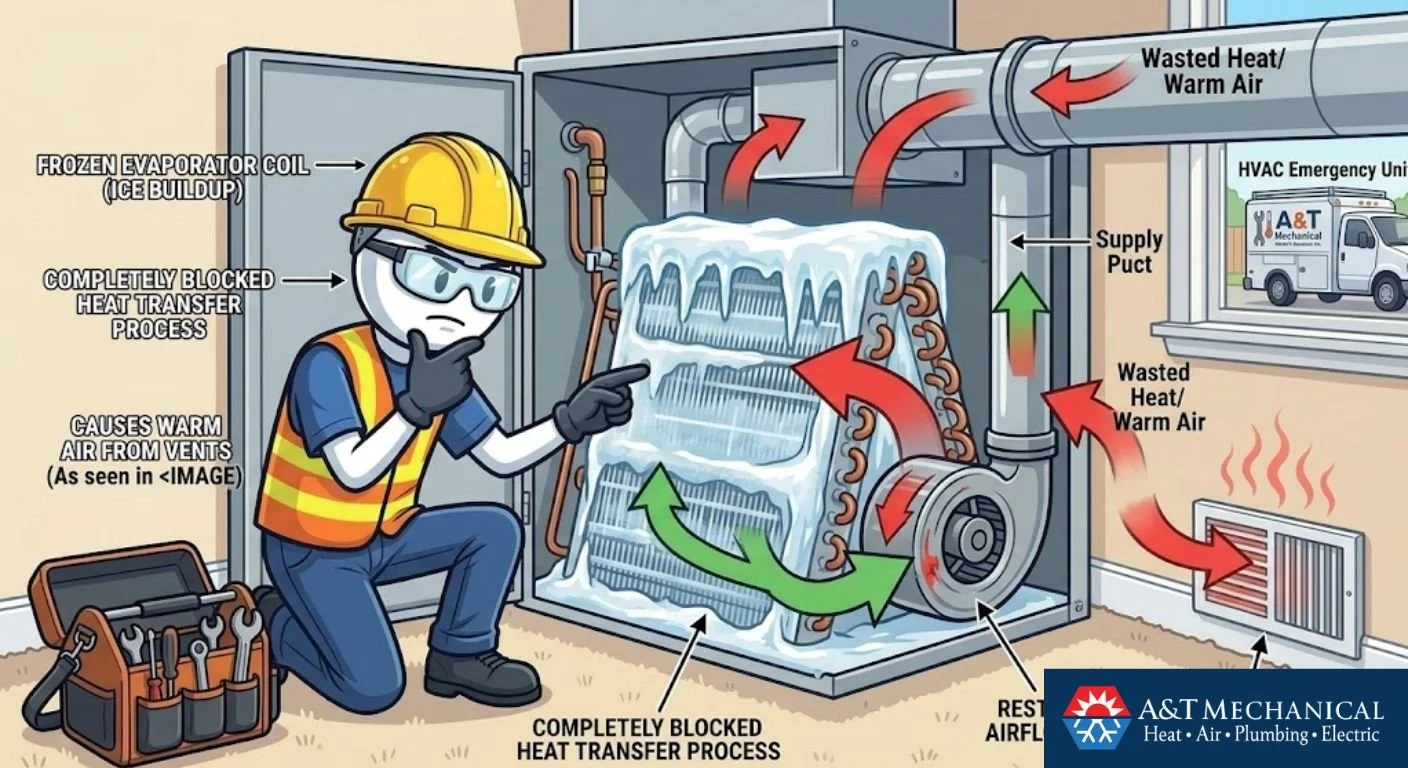
The evaporator coil is designed to be cold, but not frozen. It works by allowing warm indoor air to flow across its surface, where refrigerant inside the coil absorbs heat from the air and cools it. When ice forms on the coil's surface, it acts as an insulating barrier between the refrigerant and the air. The refrigerant can no longer effectively absorb heat from the airflow because the ice is in the way. The result is warm air from your vents and a system that's working hard while accomplishing very little.
As the ice continues to build, it can spread from the coil into the refrigerant lines and other components, potentially causing compressor damage if the situation is left unaddressed long enough. A completely ice-over coil blocks airflow almost entirely, and the melting of that ice once the system is shut off can overwhelm the condensate drain and cause water damage in the vicinity of the air handler.
What Causes an Evaporator Coil to Freeze
The two most common causes of evaporator coil icing are restricted airflow (often from a dirty filter) and low refrigerant. Both conditions cause the coil to get colder than its design temperature, allowing moisture from the passing air to freeze on the coil surface rather than condensing and draining normally. A dirty coil itself can also restrict the heat exchange process enough to cause icing. And in some cases, a failing blower motor that can't move adequate airflow across the coil is the root cause.
If you suspect a frozen coil, the immediate step is to turn the system to fan-only mode (or off entirely) and allow the ice to thaw completely before restarting. Check and replace the air filter during this downtime. If the coil refreezes after thawing and restarting with a clean filter, refrigerant, or another mechanical issue is the cause, and professional diagnosis is the necessary next step.
Problem #4: A Dirty or Failing Condenser Unit
While the evaporator coil handles the indoor side of heat transfer, the outdoor condenser unit handles the other half: releasing all that collected heat to the outside air. If the condenser can't do its job effectively, heat has nowhere to go, and your home stays warm.
How the Outdoor Unit Gets Overwhelmed in Oklahoma Summers
The condenser unit works by blowing air across the condenser coil, which carries refrigerant loaded with heat collected from your home. The fan draws in outdoor air, passes it across the coil, and the heat dissipates into the atmosphere. This process is significantly harder when outdoor temperatures are extreme, because the temperature differential between the refrigerant and the outdoor air is smaller, making heat transfer less efficient.
Now add a condenser coil that's been collecting a season's worth of cottonwood fluff, grass clippings, airborne dust, and debris between its fins. The restricted airflow through the dirty coil forces the compressor to work harder to move refrigerant, raises system pressures, reduces efficiency, and can push the compressor into heat-related stress that causes premature failure. Vegetation growing against the condenser unit compounds the problem by blocking airflow on the intake side.
Signs Your Condenser Is Struggling
A struggling condenser unit often produces warm air from supply registers despite running continuously. The outdoor unit may feel excessively hot to the touch around the top where the discharge fan exhausts air. You might notice the compressor cycling on and off more frequently than normal, which is a protective response to overheating. The unit may also be louder than usual, with the compressor producing a labored, higher-pitched sound under strain.
The Danger of Ignoring a Failing Condenser Compressor
The compressor is the most expensive single component in your HVAC system, often costing more than half the price of a complete system replacement. A compressor that's pushed into repeated heat-related stress can fail prematurely, turning what could have been a simple cleaning and maintenance service into a decision about whether to repair or replace the entire system. Keeping the condenser coil clean and ensuring adequate airflow around the unit is one of the most cost-effective preventive measures an Edmond OK, homeowner can take.
Problem #5: Ductwork Leaks and Airflow Problems
Your ducts are the delivery system for all the conditioned air your HVAC system produces. If that delivery system is compromised, you're paying to cool air that never reaches your living spaces.
How Leaky Ducts Steal Your Cooling Before It Reaches You
Studies have consistently found that the average home loses 20% to 30% of conditioned airflow through duct leaks, gaps at joints and connections, and unsealed penetrations. In practical terms, that means your system is producing 100% of the cooling it should deliver, but only 70% to 80% of it reaches the rooms you're trying to cool. The rest is dumped into unconditioned attic space, wall cavities, or crawl spaces.
The result is exactly what homeowners in Edmond OK describe: rooms that never quite reach the thermostat setpoint, uneven cooling throughout the house with some rooms comfortable and others persistently warm, and energy bills that seem disproportionately high relative to the comfort achieved.
Signs of Ductwork Problems in Edmond OK Homes
Rooms that are consistently warmer than others, particularly rooms farthest from the air handler, are a classic sign of ductwork problems. Noticeably weak airflow from specific registers, while others flow strongly, suggests a disconnected or collapsed duct section serving those rooms. Visible dust deposits around register edges can indicate duct leaks pulling unconditioned air from unconditioned spaces. A system that runs almost continuously without achieving the thermostat setpoint, particularly when the filter is clean, and the outdoor unit appears to be functioning, points toward a delivery problem rather than a generation problem.
Professional duct testing using a blower door or duct blaster equipment, along with visual inspection using a camera where accessible, can precisely quantify duct leakage and identify the specific locations where air is escaping.
Problem #6: An Oversized or Undersized AC System
Equipment sizing is one of the most commonly misunderstood factors in HVAC performance. Many homeowners assume that a bigger system automatically means better cooling. In reality, wrong-sized equipment creates persistent comfort problems regardless of how well it functions mechanically.
Why Bigger Isn't Always Better With Air Conditioning
An oversized AC system cools the air in your home quickly but shuts off before it has run long enough to adequately dehumidify the space. In Edmond, OK's humid summer climate, this is a significant problem. The air may be at the correct temperature, but feels clammy, sticky, and uncomfortable because the moisture content is too high. Oversized systems also short-cycle, meaning they turn on and off frequently, which increases wear on components and prevents stable temperature maintenance throughout the home.
An undersized system has the opposite problem: it runs continuously but can never quite reach the setpoint during the hottest days because it simply doesn't have sufficient capacity for the home's cooling load. If your system runs without stopping during extreme heat and the house temperature slowly climbs anyway, undersizing may be the cause.
Proper equipment sizing requires a professional load calculation that accounts for your home's square footage, insulation levels, window area and orientation, ceiling height, local climate data, and other factors. This calculation should be performed by a qualified HVAC Edmond OK technician before any system replacement.
Problem #7: A Failing Thermostat or Electrical Issue
Sometimes the problem isn't the AC at all. The system may be capable of cooling, but is being prevented from doing so by a control or electrical issue upstream of the mechanical equipment.
When the Problem Isn't the AC at All
A thermostat that's reading the wrong temperature will signal the AC to run when it shouldn't or stop when it should continue. A thermostat mounted near a heat source, like a sunny window, a lamp, or an appliance that generates heat, will consistently read higher than the actual room temperature and cause the system to overcool or behave erratically. A failing thermostat may lose its calibration over time and deliver inaccurate readings.
On the electrical side, a weak capacitor on the condenser unit may allow the compressor to start but prevent the condenser fan from running at full speed, reducing the unit's heat rejection capacity. A failing contactor, the electrical switch that sends power to the compressor and condenser fan, can cause intermittent operation. And a low-voltage wiring issue between the thermostat and the air handler can cause erratic control behavior that mimics a mechanical problem.
These control and electrical issues are often less expensive to diagnose and repair than mechanical problems, but they require the right diagnostic tools and electrical knowledge to identify accurately.
When to Call an HVAC Edmond OK Professional vs. DIY Fixes
Not every cooling problem requires a service call. Some things are genuinely within the reach of a careful, informed homeowner.
What Homeowners Can Safely Handle Themselves
Changing the air filter is always a homeowner's task, and it's the first thing to check before anything else. Clearing vegetation and debris from around the outdoor condenser unit is another safe homeowner action: keep at least two feet of clear space around all sides of the unit and ensure the top discharge area is unobstructed.
Checking that your thermostat is set correctly to cooling mode and that the setpoint is below the current room temperature sounds obvious, but it's missed more often than you'd think. Verifying that the circuit breakers for both the indoor air handler and the outdoor condenser unit are in the "on" position covers another common, simple cause.
Thawing a frozen evaporator coil by switching to fan-only mode is appropriate before calling for service, as the technician will need the system thawed to properly diagnose the underlying cause.
Beyond these actions, cooling problems should be addressed by a licensed professional. Refrigerant handling, electrical diagnostics, coil cleaning with appropriate chemicals, duct testing and sealing, and compressor evaluation all require training, certification, and specialized tools.
How A&T Mechanical Heat&Air Services, Inc. Diagnoses and Resolves Cooling Failures
When Edmond OK, homeowners call A&T Mechanical Heat&Air Services, Inc. for an AC not cooling, they get a thorough, systematic diagnostic process rather than a guess-and-replace approach. The team evaluates airflow, refrigerant pressure, electrical components, coil condition, outdoor unit performance, and thermostat function to identify the actual root cause rather than just treating the most visible symptom.
A&T Mechanical Heat&Air Services, Inc. brings both the diagnostic expertise and the honest communication that homeowners need when they're dealing with a failing AC during an Oklahoma summer. They explain what they find, why it's causing the problem, and what the repair options are, including cost, so homeowners can make informed decisions rather than feeling pressured into unnecessary services.
As the trusted HVAC Edmond OK team that has served this community through many summers, A&T Mechanical Heat&Air Services, Inc. understands the local climate conditions, the common failure modes in regional housing stock, and the urgency that comes with a failing AC when temperatures are climbing.
A&T Mechanical Heat & Air Services, Inc. Proudly Serving The Oaks and Surrounding Areas in Edmond, Oklahoma
A&T Mechanical Heat&Air Services, Inc. is committed to supporting the residents of The Oaks. Our location is conveniently situated near Memorial Park Cemetery, close to the intersection of Colin Trail and Green Cedar Terrace (coordinates: 35.60026162316142, -97.48418929590089), making it easy for locals to access our HVAC Edmond OK.
Trusted HVAC Services in The Oaks You Can Rely On
Call or contact us to learn more.
Directions from The Oaks to A&T Mechanical Heat & Air Services, Inc.
Conclusion
An air conditioner that runs but doesn't cool is one of the most frustrating situations an Edmond OK, homeowner can face, particularly during the months when adequate cooling is a genuine health and safety concern rather than just a comfort preference. The good news is that most of the common causes are diagnosable and fixable. Dirty filters, refrigerant leaks, frozen coils, dirty condenser units, duct losses, sizing mismatches, and thermostat issues each have specific solutions when properly identified.
The key is accurate diagnosis. Treating the wrong problem wastes money and leaves the real issue in place, which is exactly why professional diagnostic expertise matters. A&T Mechanical Heat&Air Services, Inc. delivers that expertise with every HVAC Edmond OK service call, giving homeowners the answers and solutions they need to stay comfortable through every Oklahoma summer.
Don't let a cooling problem become a compressor failure or a heat-related health emergency. Reach out to A&T Mechanical Heat&Air Services, Inc. at the first sign of trouble and get your system back to peak performance.
FAQs
1. My AC is blowing air, but it's not cold. What is the most likely cause?
The most common causes of an AC blowing warm or room-temperature air are a dirty air filter severely restricting airflow, low refrigerant due to a system leak, a frozen evaporator coil blocking heat transfer, or a dirty condenser coil preventing heat rejection outdoors. Start by checking and replacing your filter. If the filter is clean and the problem persists, the issue requires professional diagnosis to determine whether it's refrigerant, a coil issue, or an electrical problem.
2. How long should I wait before calling a professional if my AC isn't cooling?
In Edmond OK's summer heat, don't wait more than a few hours. If your home is climbing past 80 degrees with the system running and a clean filter doesn't resolve the issue, call for professional service the same day. Extended exposure to indoor heat above 85 degrees poses real health risks, particularly for elderly residents, young children, and people with health conditions. Most reputable HVAC Edmond OK companies prioritize same-day service for cooling failures during the summer months for exactly this reason.
3. Can I add refrigerant to my AC system myself? No. Refrigerant handling is federally regulated under EPA Section 608 rules and requires specific certification to purchase and handle legally. Beyond the legal requirements, adding refrigerant without first finding and repairing the leak is ineffective and wasteful. The refrigerant will simply continue escaping through the leak. A licensed HVAC technician uses electronic leak detection equipment to locate the specific leak point, repairs it, and then recharges the system to the correct pressure specification for your equipment.
4. How do I know if my AC system is the right size for my home?
Signs of an oversized system include frequent short cycling, high humidity indoors even when the air feels cool, and temperature swings throughout the day. Signs of an undersized system include continuous running during hot weather without reaching the setpoint and rooms that are consistently too warm. If you suspect a sizing issue, ask a qualified HVAC Edmond OK professional to perform a Manual J load calculation for your home. This calculation determines the precise cooling capacity your home requires and whether your current equipment matches that need.
5. What regular maintenance can I do to prevent my AC from losing cooling capacity?
Change your air filter monthly during peak cooling season, or at a minimum every 60 days. Keep the outdoor condenser unit clear of vegetation, debris, and grass clippings, maintaining at least two feet of clearance around all sides. Have the system professionally serviced once per year, ideally in spring before the cooling season begins. A professional tune-up includes cleaning the evaporator and condenser coils, checking refrigerant pressure, testing electrical components, lubricating moving parts, and verifying that all system parameters are within specification. This annual investment is the most effective preventive measure to avoid unexpected cooling failures during the hottest months.
Written by A&T Mechanical Heat&Air Services, Inc. | Updated May 2026