
Is Your Edmond OK Home's Electrical Panel a Fire Hazard? What to Check Now
Most homeowners in Edmond OK never think about their electrical panel until something forces them to. It's tucked away in a utility closet, a basement corner, or a garage wall, quietly doing its job while life happens around it. Out of sight, out of mind. The problem with that approach is that electrical panels can develop serious, fire-causing hazards over years and decades without producing a single obvious symptom until the moment they fail.
And electrical panel failures don't announce themselves politely. They announce themselves with smoke, flames, and 2 AM evacuations.
This guide is designed to help you take a proactive look at one of the most critically important safety systems in your home. We'll walk through six specific warning signs that your panel may be a fire hazard, explain what each one means and why it matters, and clearly tell you when electrical panel replacement professionals in Edmond need to be involved. This isn't about creating fear. It's about giving you the information to protect your home and your family before a preventable problem becomes one that isn't.
The Silent Fire Risk Hiding in Your Utility Closet
Electrical fires are among the most devastating residential disasters there are. They often start inside walls, in panels, or in spaces where no one is present to detect them early. By the time visible flames or smoke appear, a fire that began inside the wall has often been burning long enough to spread significantly.
Why Electrical Panels Rarely Get the Attention They Deserve
Unlike a leaking roof or a cracked foundation, an aging electrical panel gives no visible external indication that something is wrong. The panel looks the same at age 40 as it did at age 10, at least from the outside. There's no dripping water, no crumbling concrete, no obvious physical deterioration that catches the homeowner's eye during a walk-through. The degradation happens internally: corroding connections, weakening bimetal strips in breakers, deteriorating insulation on conductors, and loosening terminal screws that create resistance and heat.
This invisibility is exactly why electrical panels account for a significant portion of residential electrical fires annually and why proactive assessment is so important.
How an Aging Panel Becomes a Genuine Fire Hazard
The mechanism is straightforward, though the timeline is slow. As connections inside the panel age and develop resistance, current flowing through those high-resistance points generates heat. That heat cycles repeatedly through the panel with every load demand. Over years, the heat stresses insulation, weakens connections further, and in some cases reaches temperatures sufficient to ignite surrounding materials.
The insulation inside conduit and wiring doesn't burn easily, but it does degrade under repeated thermal cycling. Once insulation fails at a connection point inside a panel, the resulting arc can generate temperatures in excess of 35,000 degrees Fahrenheit in a fraction of a second. This is the electrical arc flash that ignites fires in panels and walls. Understanding this mechanism helps clarify why electrical panel replacement Edmond is sometimes not just a comfort or convenience upgrade but a genuine safety necessity.
Warning Sign #1: Your Panel Is Over 25 Years Old
Age is the most straightforward risk indicator for an electrical panel. It's not a guarantee of problems, but it's a strong predictor of their likelihood.
What Age Alone Tells You About Panel Safety
Electrical panels are designed with a functional lifespan, and most manufacturers rate their equipment for 25 to 40 years under normal operating conditions. But that rating assumes regular maintenance, appropriate load conditions, and a stable environment, none of which describe the reality of most residential panels in Edmond OK.
At 25 years and beyond, the bimetal strips inside circuit breakers that bend and disconnect the circuit under overload conditions have been thermally cycled thousands of times. The terminal screws that hold wire connections have expanded and contracted with temperature changes for decades, creating micro-movement that loosens connections progressively. The bus bars that distribute power to individual breakers have accumulated oxidation that increases contact resistance. None of these changes are visible without opening the panel, but all of them contribute to reduced safety and reliability.
Why Components Degrade Even Without Obvious Symptoms
Here's the aspect of electrical panel aging that makes it particularly deceptive: degrading components often continue to function well enough to not produce noticeable symptoms right up until they fail. A breaker with a weakened bimetal strip may still trip under most overload conditions. A loose connection may still carry current adequately most of the time. The panel appears to be working normally because the thresholds for obvious failure haven't yet been crossed.
But "working well enough most of the time" is not an acceptable standard for electrical safety. The failure mode of a weakened breaker or a degraded connection isn't gradual performance decline. It's sudden failure, often under peak load conditions, which is precisely when your home's electrical system is under maximum stress.
Warning Sign #2: You Have a Federal Pacific or Zinsco Panel
If your panel is one of these two brands, age is largely irrelevant because the safety concern is the fundamental design of the equipment itself.
The Documented Safety History of These Panel Brands
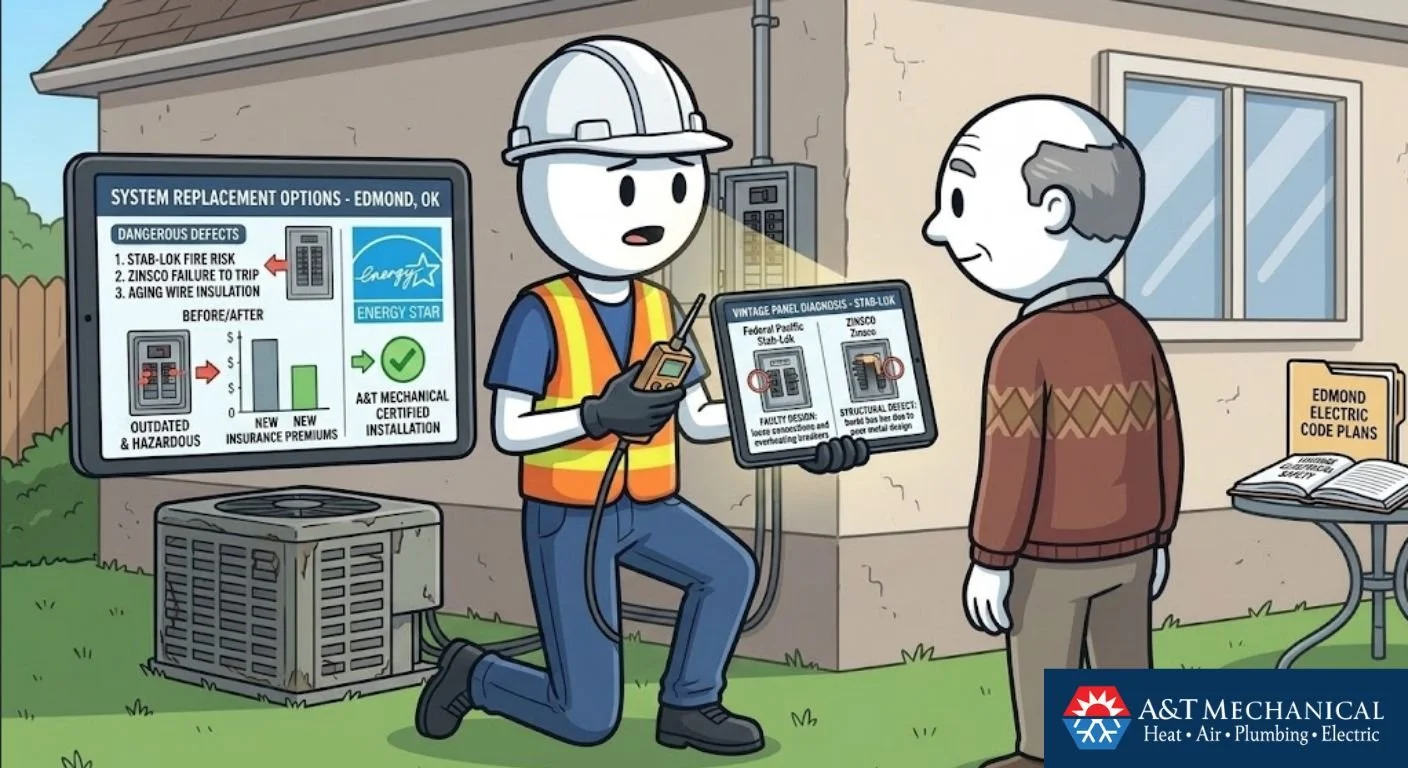
Federal Pacific Electric (FPE) Stab-Lok panels and Zinsco (also sold under the Sylvania brand) panels are the two most widely documented problem electrical panels in residential HVAC and electrical safety literature. Extensive independent testing and investigation has documented a consistent pattern with both brands: their breakers fail to trip under overload conditions at rates far above what safety standards require.
A circuit breaker that doesn't trip when it should allows overcurrent to continue flowing through the circuit, generating heat that builds until something gives way. In the case of FPE Stab-Lok panels, the breakers were found to fail to trip in a significant percentage of test cases, meaning that the primary safety mechanism of the panel was functionally unreliable. Zinsco panels have similar documented failure patterns, with the additional problem of aluminum bus bars that can develop corrosion connections and breakers that can literally melt to the bus bar, making them impossible to switch off.
These panels were installed in large numbers of homes built and renovated during the 1950s through the 1980s, and many remain in service today, including in Edmond OK homes from that era.
How to Identify If You Have One of These Panels
Identifying a Federal Pacific panel is relatively straightforward: look for the "Stab-Lok" name on the panel door or on the breakers themselves, or the "Federal Pacific Electric" or "FPE" brand name on the enclosure. The breakers are distinctive in their appearance, with a narrow profile and a somewhat unusual latch mechanism.
Zinsco panels often display the "Zinsco" or "Sylvania" brand name on the door. The breakers are often colorful, with red, blue, or green handles, and the panel itself has a distinctive midcentury appearance.
If you have either of these panels, the appropriate action is to have a licensed electrician assess the equipment and discuss electrical panel replacement Edmond options as soon as practically possible. This is not a monitor-and-wait situation.
Why These Panels Are Still in Thousands of Homes Today
The persistent presence of these panels in homes despite their known safety issues comes down to a few factors. There was never a mandatory recall that forced replacement. Homeowners who aren't aware of the issue don't know to look for it. And replacement, while not prohibitively expensive relative to the safety value it provides, does cost money that homeowners who aren't experiencing active symptoms don't feel urgency about spending. Insurance companies are increasingly aware of the issue, however, and some are now refusing to write or renew policies on homes with these panels, which is bringing the issue to the surface for many homeowners.
Warning Sign #3: Your Breakers Trip Frequently or Won't Hold
Breaker behavior is one of the most direct windows into panel health. How your breakers respond, or fail to respond, to electrical loads tells a story worth reading carefully.
What a Breaker That Trips Easily Is Actually Telling You
A breaker that trips under loads well below its rated ampacity is a breaker that's failing. The bimetal strip that controls thermal tripping has weakened through repeated cycling to the point where it responds at a lower current than its design rating. This is a mechanical failure of a safety component that needs replacement.
Frequently tripping breakers are also sometimes symptomatic of a larger issue: a panel that's undersized for the home's current electrical demand. When a circuit is chronically overloaded because there simply isn't enough capacity distributed across the panel, breakers respond by tripping repeatedly. In either case, a pattern of frequent trips signals that something needs to change at the panel level, either component replacement or a full electrical panel replacement Edmond upgrade.
The More Dangerous Scenario: Breakers That Never Trip
Counterintuitively, a breaker that never trips despite genuine overloads is a far more dangerous condition than one that trips too easily. If the bimetal strip has degraded to the point where it no longer responds to overcurrent, the breaker is no longer functioning as a safety device. It's just a switch. Current flows through the circuit unchecked regardless of how far above safe levels the demand climbs.
This is the failure mode most closely associated with fire risk. An overcurrent condition on a circuit with a non-functioning breaker means that wires heat up beyond their rated capacity. Insulation degrades. If insulation fails at a connection point or junction, arcing begins. Arcing generates intense, localized heat that ignites surrounding materials in structural cavities where it can spread undetected.
Warning Sign #4: You Smell Burning or See Scorch Marks
This is the warning sign that requires the most urgent response, because it indicates that heat damage is already occurring inside or near your panel.
What Burning Smells Near an Electrical Panel Mean
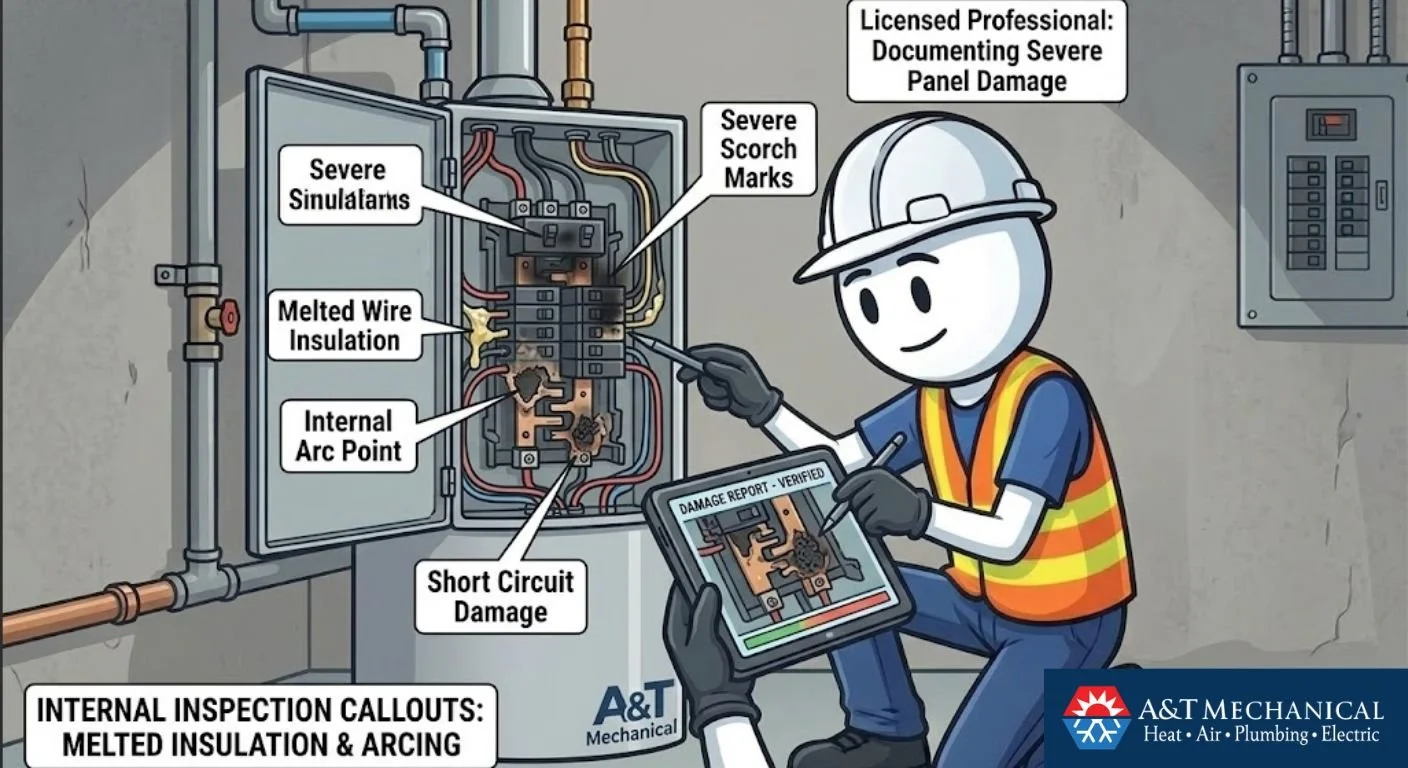
A burning smell near your electrical panel is not something to note and monitor. It's an active emergency signal. The smell of burning plastic, hot metal, or electrical char near or at the panel indicates that insulation is overheating, a component is generating excessive heat, or active arcing is occurring somewhere in the panel. Any of these conditions represents an immediate fire risk.
If you smell burning near your electrical panel, the appropriate immediate response is to shut off the main breaker if it's safe to do so (meaning there is no visible smoke or flames near it), then call a licensed electrician immediately. Do not attempt to open the panel yourself to investigate. Do not assume the smell will resolve on its own. The source of an electrical burning smell does not cool down and go away. It gets worse until something ignites or the power is cut.
Scorch Marks, Discoloration, and What They Confirm
Visible scorch marks, discoloration, or melting on the panel face, on breakers, or on the wiring visible near the panel confirm that a heat event has already occurred. Black residue around a breaker indicates that the breaker has experienced an arc or overheating event. Discolored or melted insulation on wires near terminal connections indicates that those connections have been generating heat.
These are not cosmetic issues. They're forensic evidence of a past failure event and strong predictors of future ones. Any home where scorch marks are visible in or around the electrical panel requires immediate professional evaluation, and electrical panel replacement Edmond is the likely necessary outcome.
Warning Sign #5: Your Panel Can't Keep Up With Modern Demand
Electrical demand in the average home has increased dramatically over recent decades, and many older panels weren't designed for anything close to what we ask of them today.
How Overloaded Panels Create Persistent Heat and Risk
An electrical panel that's running near its maximum capacity, meaning that the total connected load across all circuits approaches the panel's rated amperage, is a panel that's generating persistent heat simply from normal operation. Heat is the enemy of electrical components and insulation. A panel that's never under severe stress ages much more slowly than one that's regularly operating near its limits.
An overloaded panel also has far less safety margin for the kind of load spikes that happen routinely in residential use. Starting a large motor, running multiple high-draw appliances simultaneously, or even a transient surge from the utility can push an already heavily loaded panel into fault conditions.
Signs Your Home Has Outgrown Its Electrical Capacity
Specific behavioral indicators suggest an undersized or overloaded panel. Lights that dim noticeably when large appliances start up, such as when the air conditioner kicks on or the dryer starts, indicate voltage drop from insufficient capacity. A home that still runs on a 100-amp service, which was standard for homes built before the 1970s, is almost certainly undersized for a modern family's electrical demand. Circuits that trip not from a single appliance but from ordinary simultaneous use of normal household devices indicate that the load distribution across the panel has outpaced its design.
Warning Sign #6: You Have Double-Tapped Breakers or DIY Wiring
If previous owners or unqualified contractors did electrical work in your panel, specific configurations can create ongoing safety hazards.
What Double-Tapping Actually Does to a Circuit
Double-tapping refers to the practice of connecting two wires to a single breaker terminal that's designed for only one wire. This is done when a panel has run out of available breaker spaces and someone adds a new circuit by piggybacking onto an existing breaker rather than adding the required additional breaker or expanding the panel.
Double-tapping is a code violation and a fire hazard. Most breakers are designed with a single wire terminal, and adding a second wire creates a connection that's mechanically insecure. Loose connections generate heat, and heat at a breaker terminal creates fire risk. Double-tapped breakers are also problematic because the single breaker now protects two circuits, meaning the combined load of both circuits flows through one breaker before it would trip, allowing individual circuit overloads to go unchecked.
Why DIY Electrical Work Inside a Panel Is Particularly Dangerous
The inside of a main electrical panel contains energized components that cannot be de-energized by turning off the main breaker: the service entrance conductors and lugs that feed power from the utility remain live even with the main breaker off. DIY work inside a panel by unqualified individuals creates risk not just from incorrect wiring but from direct contact with these always-energized components.
Beyond the immediate danger, incorrect DIY work inside panels is a common source of the kinds of long-term hazards we've described throughout this guide: loose connections that arc, incorrectly sized breakers that allow overcurrent, and configurations that violate code requirements. A licensed electrician evaluating a home for electrical panel replacement Edmond will routinely discover DIY modifications inside panels that have been creating risk for years without the homeowner's knowledge.
What Electrical Panel Replacement Edmond Homeowners Should Do Right Now
Understanding the warning signs is the first step. Knowing what to do with that understanding is what actually protects your home.
Immediate Steps to Take If Your Panel Shows Warning Signs
If your panel shows any of the warning signs covered in this guide, start with a visual inspection: look at the panel face for scorch marks, discoloration, or any visible physical damage. Smell near the panel when the home's electrical load is active. Note whether your breakers trip under normal use or conversely seem to never trip even under heavy load. Listen for any unusual buzzing or crackling sounds near the panel, which can indicate arcing.
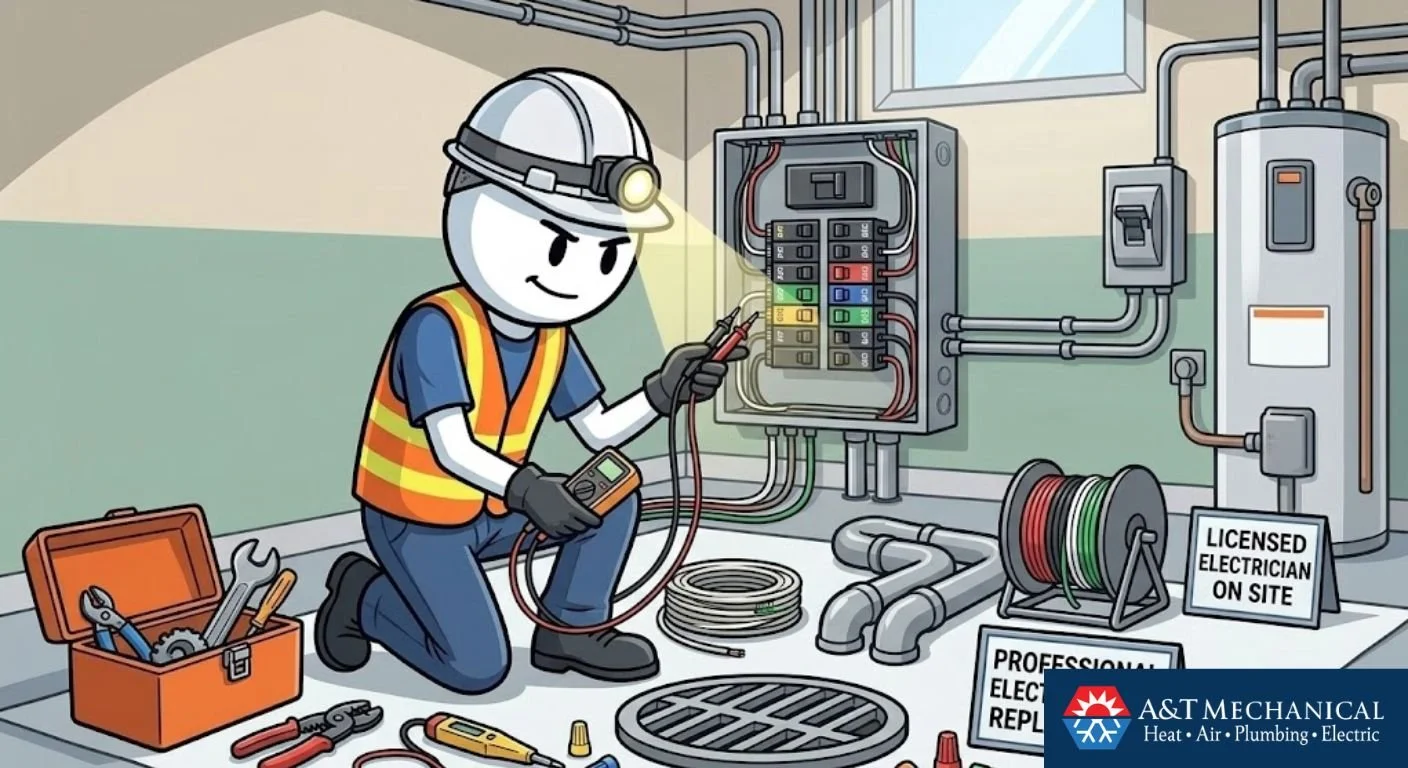
If you identify any active warning signs, particularly burning smells, visible scorch marks, or a panel that you know to be an FPE or Zinsco unit, contact a licensed electrician immediately. For less urgent concerns, schedule a professional panel inspection. A licensed electrician can open the panel safely, assess internal component condition, test breaker function, check connection integrity, and give you an accurate picture of your panel's current safety status.
Why Electrical Panel Replacement Edmond Is the Right Long-Term Answer
For panels that are significantly aged, of known problematic brands, showing signs of internal damage, or inadequate for the home's current electrical demand, electrical panel replacement Edmond isn't an optional upgrade. It's the appropriate safety response. A new, properly sized panel with modern breakers provides a safety margin that degraded older equipment simply cannot.
Modern panels include arc-fault circuit interrupter (AFCI) breakers and ground-fault circuit interrupter (GFCI) protection that older panels lack entirely. These technologies detect specific types of electrical faults that older breakers cannot, providing multiple additional layers of protection against exactly the fire and shock hazards we've discussed. They represent a significant advance in residential electrical safety that homeowners with older panels are currently missing.
The cost of electrical panel replacement Edmond, typically ranging from $1,500 to $3,000 for a standard residential upgrade, needs to be weighed against the cost of not replacing it: the potential loss of a home, the denial of insurance claims, and the personal safety risks that a fire-hazard panel creates for everyone inside.
How A&T Mechanical Heat&Air Services, Inc. Handles Panel Assessments and Replacement
When Edmond OK homeowners have concerns about their electrical panel or are ready to discuss electrical panel replacement Edmond, A&T Mechanical Heat&Air Services, Inc. is the team to call for a thorough, honest assessment.
Their licensed electricians approach panel assessments with the systematic rigor that electrical safety demands. They evaluate panel age, brand, and internal condition. They assess the home's current and anticipated electrical demand against the panel's capacity. They check connection integrity, breaker function, and the presence of any code-violating configurations. And they communicate their findings clearly and honestly, without exaggerating risks or minimizing legitimate concerns.
When panel replacement is the appropriate recommendation, A&T Mechanical Heat&Air Services, Inc. manages the entire process: proper sizing for current and future demand, equipment selection from reputable manufacturers, permit acquisition and coordination with the utility company, installation to current code standards, and final inspection. Their work is fully permitted, professionally executed, and backed by the labor warranty that reflects their confidence in doing the job right.
For Edmond OK homeowners who want a trusted partner for one of the most important safety assessments their home can receive, A&T Mechanical Heat&Air Services, Inc. delivers the expertise and integrity the job demands.
A&T Mechanical Heat & Air Services, Inc. Proudly Serving Waterfront at Oakmond and Surrounding Areas in Edmond, Oklahoma
A&T Mechanical Heat&Air Services, Inc. is committed to supporting the residents of Waterfront at Oakmond. Our location is conveniently situated near Bristol Park, close to the intersection of Santa Fe Crossing Drive and West 33rd Street (coordinates: 35.621861557119935, -97.51096893469347), making it easy for locals to access our Electrical panel replacement Edmond.
Trusted Electrical Panel Replacement Services in Waterfront at Oakmond You Can Rely On
Call or contact us to learn more.
Directions from Waterfront at Oakmond to A&T Mechanical Heat & Air Services, Inc.
Conclusion
Your electrical panel is not a set-it-and-forget-it component. It's an aging mechanical and electrical assembly that needs periodic assessment and, when the time comes, replacement. The warning signs covered in this guide, age, problematic brand identity, breaker behavior anomalies, burning smells or scorch marks, capacity deficiencies, and improper internal configurations, are the signals your home's electrical system uses to tell you that professional attention is needed.
In Edmond OK, homeowners have access to exactly the right professional resource through A&T Mechanical Heat&Air Services, Inc. Whether you've noticed warning signs, haven't thought about your panel in years, or are simply being proactive about your home's safety, reaching out for a professional panel assessment is one of the highest-value protective actions you can take. The cost of being wrong about your panel's safety is too high to leave to chance.
Don't wait for a 2 AM smoke detector to tell you what a licensed electrician could have told you this week. Contact A&T Mechanical Heat&Air Services, Inc. and schedule your panel assessment today.
FAQs
1. How do I know if I have a Federal Pacific or Zinsco panel without calling an electrician?
Both panels have identifying features you can check yourself. Federal Pacific Stab-Lok panels typically display the brand name "Federal Pacific" or the product name "Stab-Lok" on the panel door or on the individual breakers. The breakers themselves have a distinctive narrow, rectangular profile. Zinsco and Sylvania panels usually display those brand names on the panel enclosure and are recognizable by their often colorful breaker handles in red, blue, or green. If you find either of these brands in your home, schedule a professional assessment and discuss electrical panel replacement Edmond options as soon as possible.
2. Is it safe to stay in my home if I suspect my electrical panel is a fire hazard?
It depends on the severity of the indicators. If you're experiencing active warning signs like burning smells, scorch marks, sparking, or any other indication of imminent failure, treat it as an emergency and evacuate if necessary. Contact an emergency electrician immediately. If the concern is based on age or brand identification without active failure symptoms, the appropriate response is prompt scheduling of a professional assessment rather than immediate evacuation. Working smoke detectors and a working fire extinguisher provide meaningful additional protection while the assessment is scheduled.
3. Can I just replace the individual bad breakers instead of doing a full electrical panel replacement?
In some cases, replacing specific failed breakers within an otherwise sound panel is an appropriate and cost-effective response. However, when the panel itself is the concern, as with FPE or Zinsco units where the fundamental design is the problem, or when the panel is significantly aged with widespread internal degradation, replacing individual breakers doesn't address the underlying safety issues. A licensed electrician can assess whether targeted component replacement is an appropriate solution or whether full electrical panel replacement Edmond is the necessary approach for your specific situation.
4. How long does an electrical panel replacement typically take?
A standard residential electrical panel replacement typically takes one day. The process includes disconnecting service from the utility, removing the old panel, installing and wiring the new panel, reconnecting all circuits, and restoring service after the work passes inspection. The home will be without power for a portion of the day during the installation. Your electrician will coordinate with the utility company for the service disconnect and reconnect, and the specific timeline depends on utility scheduling in addition to the installation work itself.
5. Will my homeowner's insurance cover damage caused by an aging electrical panel?
It depends on the specific circumstances and your policy terms. Many insurance policies exclude damage caused by known hazards that the homeowner failed to address, including documented problem panel brands like FPE and Zinsco. Some insurance carriers now specifically ask about panel brand and age during the underwriting process, and certain problematic panels may result in policy non-renewal or claim denial. Proactively replacing a problem panel not only eliminates the fire risk but also removes a potential insurance coverage complication. Consult your insurance provider about how your current panel affects your coverage before and after replacement.
Written by A&T Mechanical Heat&Air Services, Inc. | Updated May 2026