
Emergency Plumber in Edmond OK: What to Do When Pipes Burst at 2AM
You're jolted awake in the dead of night by a sound you've never heard before. A rushing, gurgling noise somewhere inside your walls or beneath your floors. You step out of bed, and your feet hit cold, wet carpet. Or you walk into the kitchen and find water streaming across the floor from somewhere under the sink. Your heart rate spikes, your mind races, and the question hits you immediately: what do I do right now?
Burst pipes at 2AM are one of the most disorienting emergencies a homeowner can face. The combination of sleep deprivation, active water damage, and the pressure to make fast decisions can lead people to do exactly the wrong things in those critical first moments. And in a plumbing emergency, the wrong decisions made in the first ten minutes can double or triple the damage done by the burst pipe itself.
This guide is your calm voice in that chaotic moment. We're going to walk you through exactly what to do, in what order, and why each step matters. We'll also explain when and why calling a trusted plumbing Edmond professional like A&T Mechanical Heat&Air Services, Inc. is the most important call you'll make that night.
Why Burst Pipes Are One of the Most Urgent Home Emergencies You'll Face
A burst pipe isn't like a dripping faucet or a slow-draining sink. Those are inconveniences. A burst pipe is an active, escalating crisis that doesn't pause while you figure out what to do.
The Speed of Water Damage: Why Every Minute Matters
Water moves fast and it moves indiscriminately. A single burst pipe can release hundreds of gallons of water in a short period, saturating floors, subfloor material, drywall, insulation, and structural framing within minutes. Hardwood floors begin to warp. Drywall soaks up moisture and becomes a breeding ground for mold within 24 to 48 hours. Electrical systems in contact with standing water create shock hazards. Structural wood components exposed to prolonged moisture weaken over time.
The damage curve in a burst pipe scenario is steep and fast. The longer water flows freely, the more exponentially worse the outcome becomes. Stopping the water quickly, taking the right immediate steps, and getting a qualified plumbing Edmond technician on-site as fast as possible is the formula for minimizing what could otherwise become a catastrophic loss.
Why Burst Pipes Happen at Night More Than You Think
It's not just your imagination. Pipe failures do tend to occur more frequently during overnight hours, and there are real physical reasons for it. Temperatures drop to their lowest point in the early morning hours, which is when freeze-related pipe failures are most likely. Water pressure in municipal systems tends to be higher overnight because overall demand is lower, meaning more force is pushing through your pipes while you sleep. And because nobody is using water, there's no natural pressure relief happening in the system.
The result is that the burst pipe that wakes you at 2AM has often been building to that failure point for hours, choosing that quiet window to give way. Understanding this helps you recognize why these overnight emergencies are so common and why being prepared for them matters.
The Most Common Reasons Pipes Burst
Understanding why pipes fail is useful both for responding in the moment and for preventing future emergencies. Burst pipes are rarely random events. They're the end result of conditions that have been developing over time.
Freezing Temperatures and Pipe Expansion
Water is unusual among liquids in that it expands when it freezes. When water inside a pipe turns to ice, that expansion creates pressure that the pipe simply cannot contain indefinitely. The pipe doesn't burst where the ice forms, interestingly enough. It bursts at the point of greatest pressure between the ice blockage and a closed faucet or valve, where pressure has nowhere to go.
Pipes in exterior walls, unheated crawl spaces, attics, and garages are most vulnerable to freeze-related bursts. When temperatures in Edmond OK drop sharply overnight, these exposed sections can freeze quickly, especially if there's been a sudden cold snap after a period of warmer weather that may have left homeowners unprepared.
Age, Corrosion, and Material Failure
Pipes don't last forever. Galvanized steel pipes, common in homes built before the 1960s, are highly susceptible to internal corrosion that gradually thins the pipe walls from the inside out. Over the decades, these walls can become so compromised that normal water pressure alone is enough to cause a failure. Copper pipes are more durable but still subject to pinhole corrosion, particularly in homes with acidic or highly chlorinated water. CPVC plastic pipes become brittle with age and can crack or shatter under stress.
Older homes with original plumbing that has never been assessed or updated carry a significantly higher risk of pipe failure, and often the failure occurs at the weakest point in the system without any obvious prior warning.
Sudden Pressure Surges in the Water Line
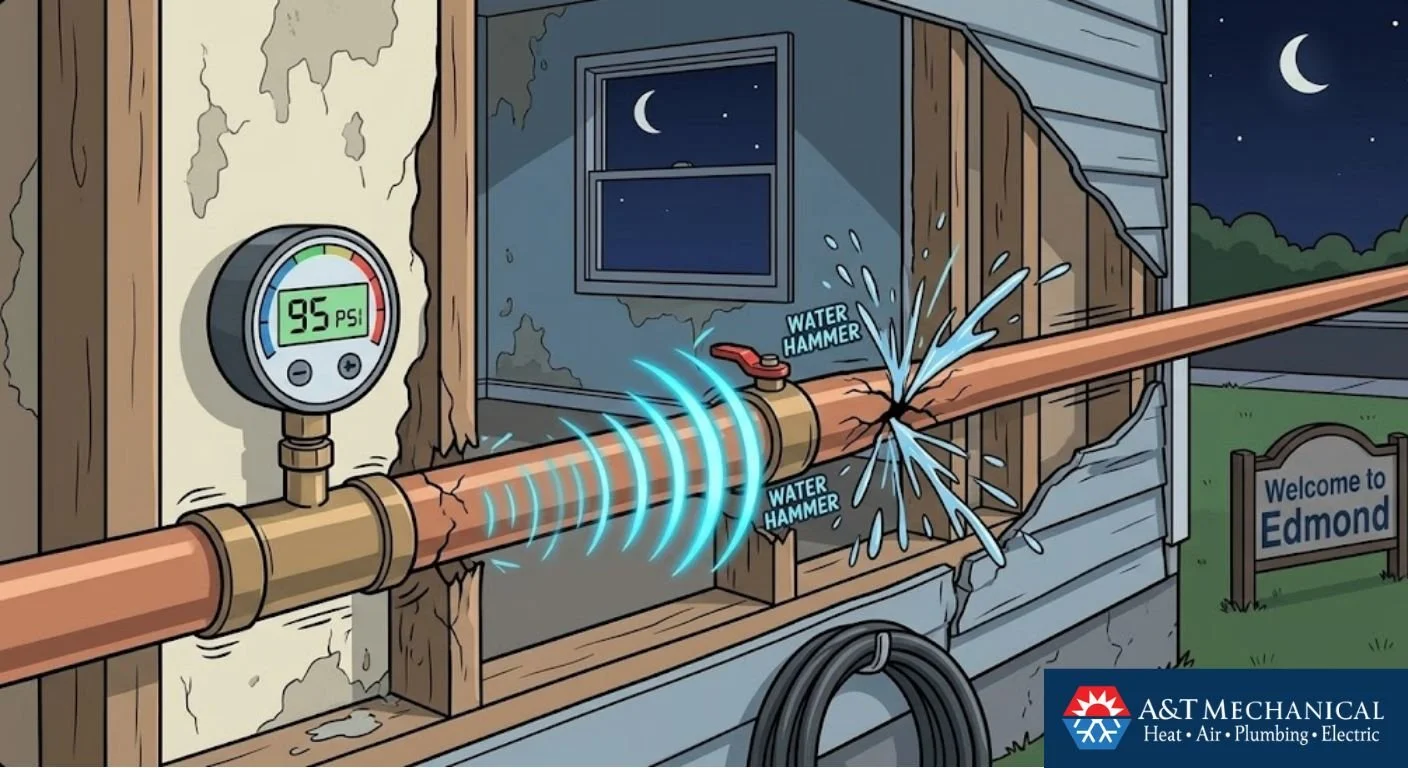
Most residential plumbing systems are designed to handle water pressure in the range of 40 to 80 PSI. When pressure exceeds this range, the stress on pipes, joints, and fittings escalates rapidly. A pressure surge can originate from the municipal supply, from a failing pressure-reducing valve (PRV) in your home's system, or from the rapid closing of a valve that causes pressure to slam back through the line.
The Hidden Role of Water Hammer in Pipe Failures
Water hammer is the banging or thudding sound you sometimes hear when a faucet or appliance valve closes quickly. It happens because the sudden stop of fast-moving water creates a shockwave that travels back through the pipe. A single water hammer event isn't usually catastrophic, but repeated water hammer over months and years fatigues pipe joints and fittings, weakening them to the point where a relatively routine pressure event finally causes a failure. Homes without water hammer arrestors are particularly vulnerable to this type of progressive damage.
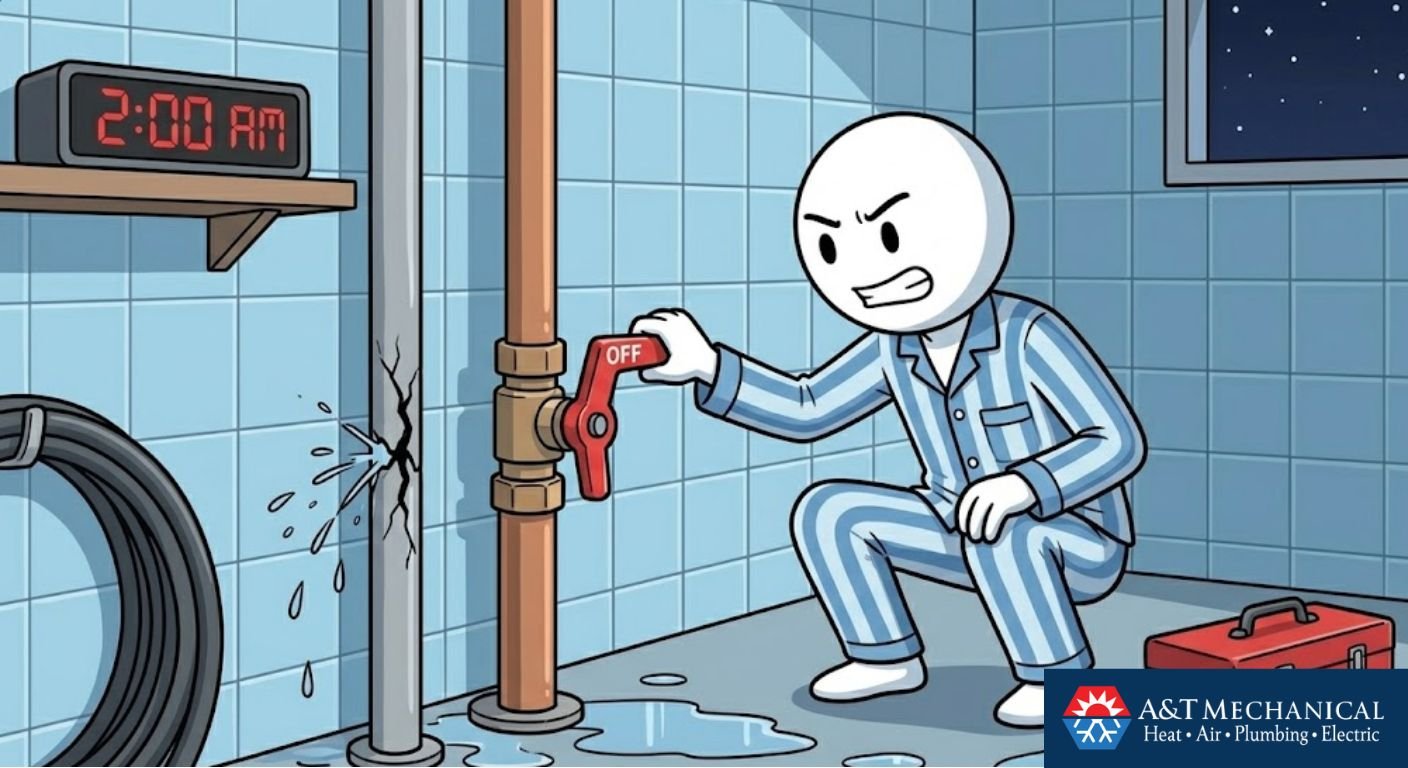
Your Step-by-Step Response When a Pipe Bursts at 2AM
Now for the most important section of this guide. Here is the exact sequence of actions to take when you're woken in the night by a burst pipe.
Step One: Shut Off the Main Water Supply Immediately
This is the single most important action you can take, and it needs to happen within the first 60 seconds if at all possible. Your main water shutoff valve controls all water flow into your home from the municipal supply. When you shut it off, the active flooding stops. Not slows, stops.
The problem is that most homeowners have never located their main shutoff or used it. Now is not the time to be searching for it in the dark. Before you ever need it, find your main shutoff and make sure every adult in your household knows where it is and how it works. It's most commonly found at the front of the house near the foundation, under the kitchen sink, in a utility room, or in the garage. In some homes, the main shutoff is in the basement or in an exterior meter box.
Gate valves, the older round-handle style, require multiple turns to close fully. Ball valves, the more modern lever-style, close with a quarter turn. Know which type you have before you need it.
Step Two: Turn Off the Water Heater
With the main supply off, your water heater is no longer receiving cold water to heat. If it continues to operate without a supply, it can overheat, damage the heating elements, and in extreme cases, create a dangerous pressure situation inside the tank. Turn your water heater to the "pilot" setting for gas units or switch it off at the breaker for electric units immediately after cutting the main water supply.
Step Three: Open Faucets to Relieve Remaining Pressure
Even after the main is shut off, water remains in your pipes under pressure. Opening cold water faucets throughout the home, starting with the lowest level, allows that residual pressurized water to drain out in a controlled way rather than continuing to seep from the burst point. This step also helps you identify which pipes are still holding water and reduces the ongoing flow from the damaged area.
Step Four: Begin Containing the Water Damage
Once the water flow is stopped or significantly reduced, your focus shifts to limiting damage. Grab every towel, bucket, and mop you have and start managing the standing water. Move furniture off wet flooring if you can do so quickly and safely. Lift rugs and place them somewhere dry. If the water has reached a room with electronics or appliances, prioritize getting those items elevated or removed from the wet area.
If the ceiling is sagging or dripping from water accumulation above, place a bucket and be cautious. A waterlogged ceiling section can collapse under its own weight, which creates a dangerous situation and significantly worsens the damage.
Step Five: Document Everything Before Cleanup
Before you clean up more than the absolute minimum necessary to prevent immediate harm, take photographs and video of everything. Every wet surface, every visible damage point, every area of standing water, the burst pipe itself if visible. This documentation is your evidence for the homeowner's insurance claim that will likely follow, and the more thorough your documentation, the stronger your claim. Your insurance company will want to see the extent of the damage before remediation work begins.
What NOT to Do When a Pipe Bursts
Knowing what to avoid is just as important as knowing what to do. Under stress and sleep deprivation, it's surprisingly easy to make decisions that make an already serious situation worse.
Never Ignore Electrical Hazards Near Standing Water
Water and electricity are a potentially fatal combination. If standing water has reached any area near electrical outlets, panels, appliances, or wiring, do not enter that area until you've turned off power to the affected zones at the breaker panel. If the breaker panel itself is in an area with standing water, or if you have any doubt about whether it's safe to access, don't touch it. Call the utility company and ask them to disconnect service at the meter before you proceed.
This isn't an area for risk-taking. Electrocution from contact with energized water kills people every year. Physical property damage, however severe, is recoverable. Your safety is not negotiable.
Don't Attempt Pipe Repairs Without Professional Tools and Training
We understand the impulse to fix the problem yourself. At 2AM, the idea of waiting for a plumber while water damage accumulates is deeply uncomfortable. But applying a temporary fix to a burst pipe without the proper tools, training, and knowledge of your home's plumbing system can make things worse in ways that aren't immediately obvious.
Improvised patches on pressurized pipes often fail. Overtightening fittings on weakened pipes can extend the crack. And working on pipes without a complete understanding of your system's layout can accidentally create secondary issues while you're trying to address the primary one. Your job at 2AM is to stop the water flow with the main shutoff, limit the damage, and get a qualified plumbing Edmond professional on-site as quickly as possible. Leave the repair to the people with the right tools and training for the job.
When to Call an Emergency Plumbing Edmond Professional
The honest answer is: call as soon as you've shut off the main water and confirmed there are no immediate safety hazards. Don't wait until morning. Don't hope the situation will somehow resolve itself. A burst pipe is a textbook emergency call scenario, and a professional plumbing Edmond service exists specifically to respond to situations exactly like this one.
Signs the Situation Requires Immediate Professional Intervention
Every burst pipe warrants an emergency call, but certain signs indicate particularly urgent situations. If the source of the burst is inside a wall or ceiling and you can't see the damage, the extent of the problem is unknown and potentially extensive. If multiple areas of your home show water infiltration, you may be dealing with more than one failure point. If you can smell sewage along with the water, the failure may involve your drain or sewer system, which introduces serious health hazards into the equation. If any part of your ceiling appears to be bulging or sagging under water weight, the structural risk is immediate.
How Plumbing Edmond Technicians Assess a Burst Pipe Emergency
When a licensed plumbing Edmond technician arrives at an emergency call, their first priority is safety assessment. They'll confirm that electrical hazards are controlled, identify all active or potential water sources, and assess the structural condition of the affected areas. From there, they use specialized tools including moisture meters, thermal imaging cameras, and pipe inspection equipment, to locate the exact failure point and assess how much of the system is involved. This diagnostic accuracy is what allows them to execute the right repair rather than guessing and hoping.
How A&T Mechanical Heat&Air Services, Inc. Responds to Plumbing Emergencies
When a plumbing Edmond emergency strikes in the middle of the night, you need a team that picks up the phone and responds with urgency and professionalism. A&T Mechanical Heat&Air Services, Inc. is exactly that team.
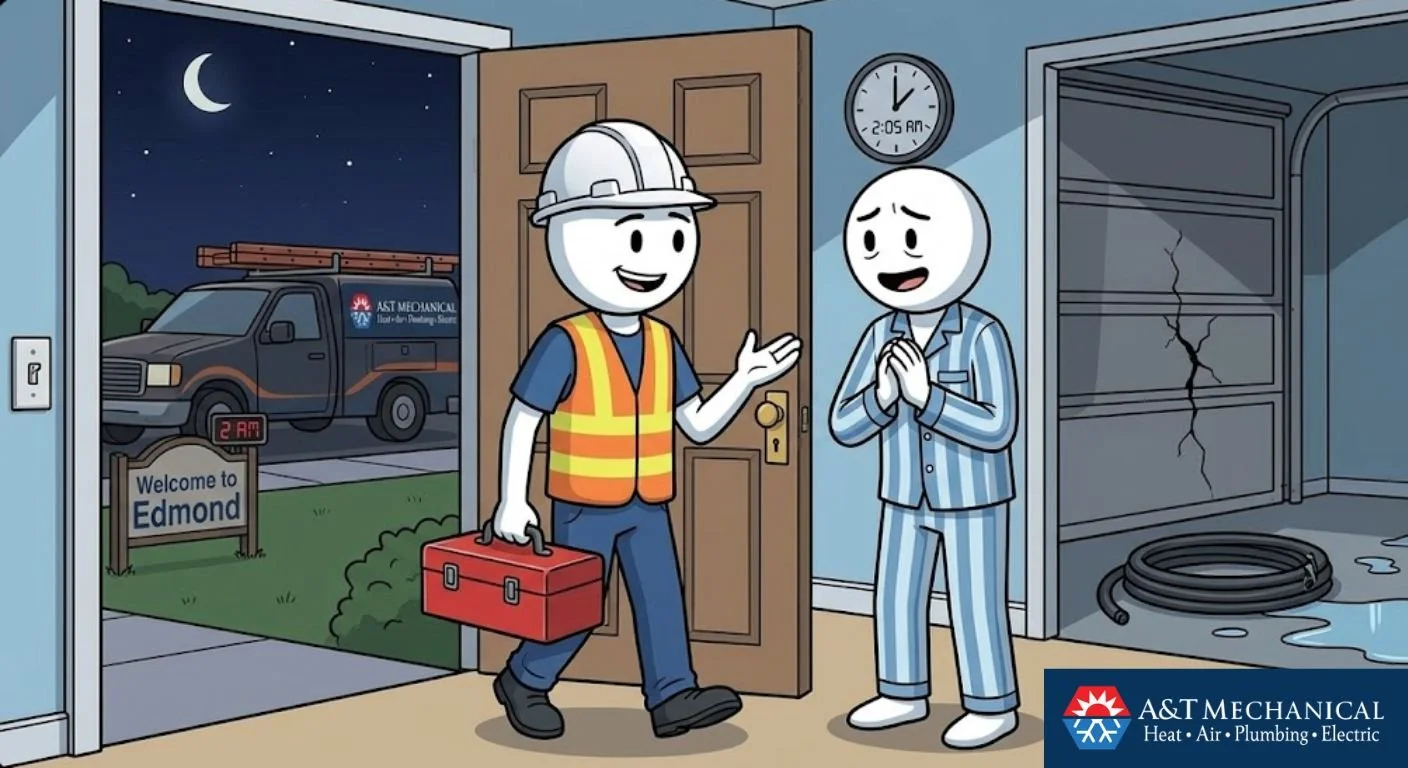
What to Expect When You Call for Emergency Plumbing Edmond Service
From the moment you reach A&T Mechanical Heat&Air Services, Inc., you're dealing with experienced professionals who understand that every minute of active water damage matters. They respond quickly, arrive equipped with the tools and materials needed for emergency pipe repairs, and work systematically to stop the damage, identify the failure point, and execute a proper repair rather than a temporary patch.
What sets A&T Mechanical Heat&Air Services, Inc. apart in an emergency is their commitment to honest, clear communication under pressure. They explain what they find, what needs to be done, and what the options are, in plain language, even at 2AM. They treat every emergency call with the professionalism and care that homeowners deserve when they're at their most vulnerable. When you need plumbing Edmond emergency service you can trust, A&T Mechanical Heat&Air Services, Inc. is the team to call.
How to Prevent Burst Pipes Before They Happen
The best burst pipe scenario is the one that never happens. A few smart preventive practices dramatically reduce your risk of facing a 2AM emergency in the first place.
Winterizing Your Plumbing System
Before cold temperatures arrive, take a systematic approach to protecting vulnerable pipes. Insulate pipes in exterior walls, crawl spaces, attics, and garages with foam pipe insulation, which is inexpensive and easy to install. Know where your most exposed pipes are and make sure they have adequate insulation against outdoor temperatures.
During cold snaps, keep your home's interior temperature above 55 degrees Fahrenheit even when you're away. Open cabinet doors under kitchen and bathroom sinks along exterior walls to allow warm air to circulate around the pipes behind them. If you're leaving for an extended period during winter, consider having your plumbing system winterized by a professional and shutting off the main water supply before you go.
A slow drip from faucets connected to exterior wall pipes during extreme cold is a widely recommended preventive measure. The movement of water through the pipe prevents static water from freezing and building pressure.
Regular Inspections That Catch Problems Early
Many burst pipe emergencies are entirely predictable to a trained professional eye. Corrosion, thinning pipe walls, weakened joints, and pressure issues that are invisible to the average homeowner are readily identifiable during a professional plumbing inspection. Having a licensed plumbing Edmond technician assess your system every two to three years, or annually in older homes, creates the opportunity to address vulnerabilities before they become emergencies.
Replacing aging galvanized steel pipes with modern copper or PEX tubing, installing a pressure reducing valve if your system runs at elevated pressure, and adding water hammer arrestors to high-velocity lines are all investments that significantly reduce emergency risk. These aren't dramatic or expensive interventions. They're exactly the kind of smart, proactive maintenance that prevents the 2AM disaster scenario entirely.
A&T Mechanical Heat & Air Services, Inc. Proudly Serving Burendale Heights North and Surrounding Areas in Edmond, Oklahoma
A&T Mechanical Heat&Air Services, Inc. is committed to supporting the residents of Burendale Heights North. Our location is conveniently situated near Chanh Phap Buddhist temple, close to the intersection of North East 117th Street and Silverleaf Lane (coordinates: 35.589348267020384, -97.47079999561913), making it easy for locals to access our Plumbing Edmond.
Trusted Plumbing Services in Burendale Heights North You Can Rely On
Call or contact us to learn more.
Directions from Burendale Heights North to A&T Mechanical Heat & Air Services, Inc.
Conclusion
A burst pipe at 2AM is one of the most stressful home emergencies imaginable, but it doesn't have to become a catastrophe. With the right immediate response, clear thinking about safety, and a qualified plumbing Edmond professional on the phone within minutes, the damage can be contained, and the repair can be executed correctly. The homeowners who come through burst pipe emergencies with the least damage and the fastest recovery are the ones who knew their main shutoff location, stayed calm, and called for professional help immediately.
In Edmond OK, A&T Mechanical Heat&Air Services, Inc. is the emergency plumbing Edmond team that homeowners trust when it matters most. Their expertise, responsiveness, and genuine commitment to protecting your home make them the right call at any hour. Save their number before you need it, know where your main shutoff is, and rest a little easier knowing you're prepared.
FAQs
1. How quickly can a burst pipe cause serious structural damage to my home?
Water damage begins accumulating almost immediately after a pipe bursts. Flooring materials can begin to warp within hours. Drywall and insulation absorb water rapidly and begin supporting mold growth within 24 to 48 hours under the right conditions. Structural wood components exposed to prolonged moisture weaken over days to weeks. The faster you stop the water flow and get a professional on-site, the lower your total damage and remediation cost will be. Every hour of active water flow matters significantly.
2. Will my homeowner's insurance cover a burst pipe at 2AM?
In most cases, yes. Standard homeowner's insurance policies typically cover sudden and accidental water damage from burst pipes, including the cost of repairing the pipe, drying out affected areas, and restoring damaged materials. Coverage for the actual plumbing repair varies by policy. What's typically not covered is damage resulting from neglect or gradual deterioration that the homeowner failed to address. Document everything thoroughly with photos and video before cleanup begins, and notify your insurance company as soon as possible after the emergency is stabilized.
3. Where is the main water shutoff in most homes, and how does it work?
Main water shutoff locations vary by home design, but the most common locations are near the front foundation wall of the basement or crawl space, under the kitchen sink, in a utility or mechanical room, in the garage near the front of the home, or in an exterior meter box near the street. The valve type matters: a round gate valve requires multiple full rotations to close completely, while a lever-style ball valve closes with a single quarter turn. Walk through your home now, find your shutoff, and test it so you know it's operational before you ever need it in an emergency.
4. Is it safe to stay in my home after a pipe bursts while waiting for a plumber?
It depends on the extent of the damage and whether electrical hazards are present. If water has contacted electrical outlets, appliances, or your breaker panel, turn off power to the affected areas before proceeding and assess safety carefully. If the water damage is localized and electrical systems are not at risk, you can generally remain in the home while managing the immediate damage. If ceiling sections are sagging, if sewage odor is present, or if the structural integrity of any area seems compromised, exercise extreme caution and consider moving to an unaffected area of the home until a professional has assessed the situation.
5. Can I do anything to slow or temporarily stop water from a burst pipe before the plumber arrives?
The single most effective action you can take is shutting off the main water supply, which stops all flow to the burst section. Beyond that, temporary pipe repair clamps or plumber's tape can be applied to slow a small, accessible burst on a straight section of pipe, but these are truly temporary measures that a professional will need to properly address. Avoid attempting repairs on pipes that are under active pressure, located inside walls, or in areas where you cannot clearly see the full extent of the damage. Your primary goal before the plumber arrives is water containment and damage limitation, not pipe repair.
Written by A&T Mechanical Heat&Air Services, Inc. | Updated May 2026