
Drain Cleaning in Edmond OK: Why Clogged Drains Are More Serious Than You Think
We've all been there. You're brushing your teeth and notice water pooling in the sink instead of draining cleanly. Or you're in the shower and suddenly standing in an inch of water. Or the kitchen sink takes longer than usual to empty after doing the dishes. Easy fix, right? A little drain cleaner from the grocery store, maybe a plunger, and you're good to go.
Not quite.
What most homeowners in Edmond, OK, treat as a minor plumbing nuisance is often the surface signal of something far more serious developing beneath their floors and behind their walls. Clogged drains are one of the most underestimated household problems there is, and leaving them unaddressed, or handling them with the wrong approach, can lead to consequences that are genuinely costly and potentially dangerous.
This article is going to change the way you look at a slow drain. We'll cover what actually causes clogs, why the dangers go so much deeper than slow water flow, why chemical drain cleaners are often making your situation worse, and how professional plumbing Edmond, OK, delivers lasting solutions that protect your home for the long haul.
The Clogged Drain Problem Most Homeowners Underestimate
There's a reason drain clogs don't get the same urgency as, say, a burst pipe or a gas leak. They don't announce themselves dramatically. They creep up slowly. Water drains a little more sluggishly this week than last week. A faint gurgling sound comes from the bathroom sink after you use the kitchen. The warning signs are subtle, easy to dismiss, and even easier to temporarily mask with a product that promises to clear the clog in minutes.
But beneath that seemingly manageable inconvenience is a plumbing system quietly struggling, and sometimes quietly failing.
Why a Slow Drain Is Never Just a Minor Inconvenience
A slow drain is your plumbing system's version of a cough that just won't go away. On its own, a cough isn't dangerous. But if you ignore it long enough without understanding what's causing it, the underlying issue can develop into something much more serious. A slow drain is exactly the same. It means water isn't moving through your pipes the way it should, and something is obstructing that flow. The longer that the obstruction stays in place, the worse it gets, the more pressure it creates, and the more damage it risks causing to the surrounding pipe infrastructure.
How Plumbing Edmond OK Professionals Define a "Serious" Clog
When a trained plumbing Edmond OK technician talks about a serious clog, they're not just referring to a complete blockage. A partial blockage that's been building for months is often considered equally serious, because the slow accumulation of material inside the pipe creates conditions that accelerate corrosion, invite bacterial growth, and increase the likelihood of a sudden, catastrophic backup. The professional lens sees not just what the drain looks like today, but what it's trending toward if left untreated.
What Actually Causes Drains to Clog?
Understanding the cause is the first step toward understanding the urgency. Drain clogs aren't random events. They're the predictable result of what goes down your drains every single day.
The Most Common Culprits Behind Blocked Drains
In kitchen drains, the primary offenders are grease, cooking oil, and food particles. Grease is particularly insidious because it goes down the drain as a liquid when it's hot, but solidifies as it cools inside the pipe, adhering to the pipe walls and gradually narrowing the passage. Over time, that narrowed passage traps food particles, soap residue, and other debris until the flow is severely restricted.
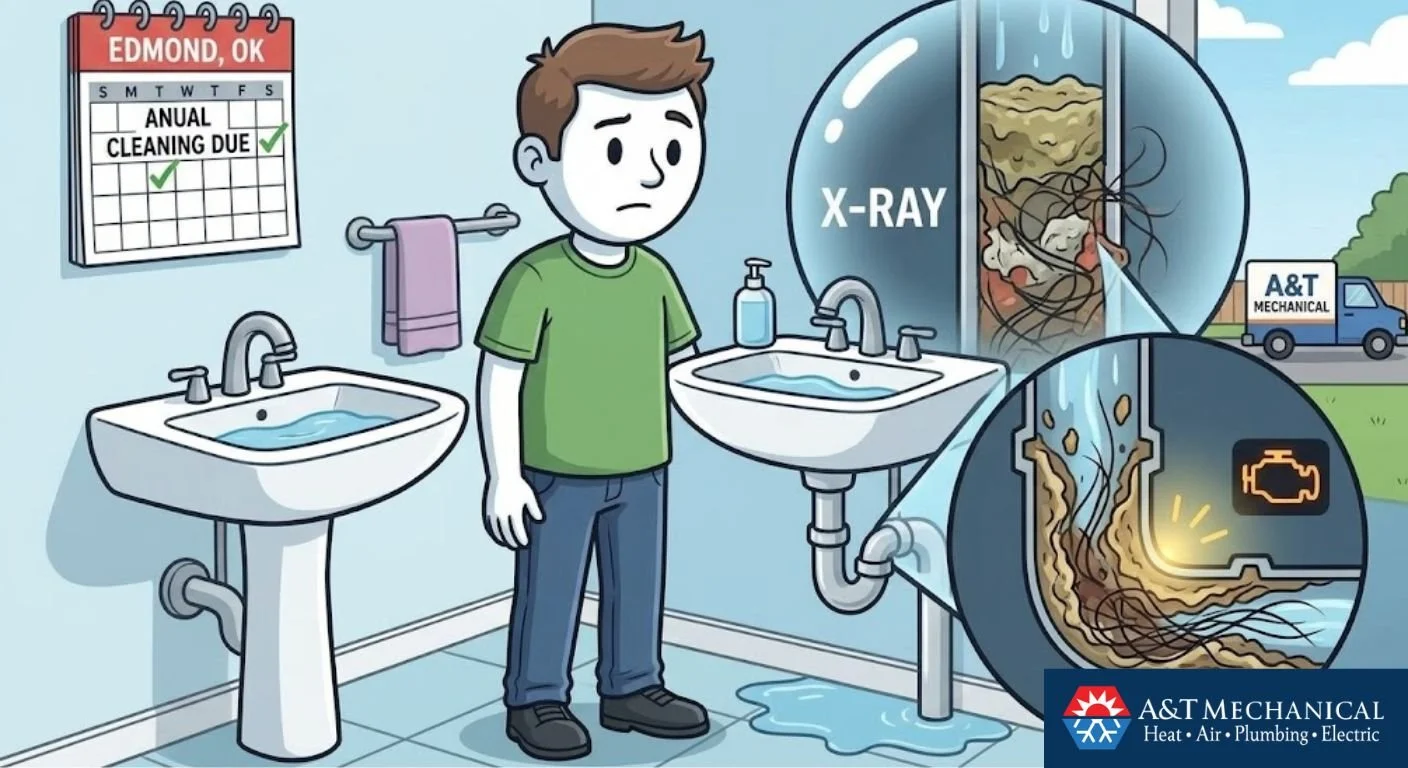
In bathroom drains, the main culprits are hair, soap scum, and toothpaste residue. Hair is the number one bathroom drain blocker. A single shower sends dozens of strands down the drain, and they tangle together into a mesh that catches everything else that flows past it. Combine that with the sticky film left by bar soap and shampoo, and you have a slow-building blockage that compounds over months.
In toilets, the problem is usually non-flushable items. Wipes that are marketed as "flushable" are one of the most common causes of serious toilet and sewer line clogs. They don't break down like toilet paper, and they accumulate in sewer lines in large masses that can cause widespread backups throughout an entire plumbing system.
How Buildup Happens Gradually and Silently
Here's what makes drain clogs particularly deceptive: the buildup almost never happens all at once. It's a slow, invisible process that takes place inside pipes you can't see. A pipe that's 80% blocked might still drain well enough that you don't notice a serious problem. But that remaining 20% of flow capacity is under stress every time water tries to push through. And one day, without much warning, that final 20% gets blocked, and the drain stops entirely, often at the worst possible moment.
The Role of Hard Water in Accelerating Drain Blockages
Hard water, which is water with elevated concentrations of minerals like calcium and magnesium, is a significant but overlooked contributor to drain blockages. As hard water moves through pipes, it leaves behind mineral deposits on the inner pipe walls. These deposits, known as scale, gradually reduce the diameter of the pipe and create a rough interior surface that traps grease, hair, and soap residue far more aggressively than a smooth pipe would. Homes with hard water can experience drain blockages at a significantly accelerated rate, making regular professional cleaning even more important.
The Hidden Dangers of Ignoring a Clogged Drain
If slow drainage were the only consequence of a neglected clog, the stakes would be manageable. But a clogged drain is often the first domino in a sequence of increasingly serious problems.
Structural Damage to Your Pipes and Home Foundation
Persistent clogs create pressure. When water has nowhere to go, it pushes against whatever is in its way, including the pipe itself. Over time, that constant pressure can stress pipe joints, cause connections to loosen, and in older homes with already-compromised plumbing, lead to pipe cracks or complete pipe failures.
When a pipe fails inside a wall or beneath a floor slab, the resulting water damage is extensive and expensive. Water saturates insulation, subfloor material, and structural wood components. If it reaches your home's foundation, it can compromise the concrete through a process called hydrostatic pressure, where water pushes against and eventually cracks foundation walls. What started as a slow drain can, in a worst-case scenario that unfolds over time, become a structural issue that costs tens of thousands of dollars to repair.
Mold, Mildew, and the Health Risks Nobody Talks About
Stagnant water is a breeding ground for mold and mildew. When a drain isn't clearing properly, water lingers in pipes, traps, and the spaces around plumbing fixtures. That moisture creates the exact conditions mold needs to establish itself: darkness, warmth, and consistent humidity.
Mold growth behind walls and under floors is particularly dangerous because it's invisible. By the time you smell it or see visible signs on a surface, the infestation has often already spread significantly within the wall cavity. Mold exposure causes respiratory problems, allergic reactions, headaches, and in people with compromised immune systems, serious health complications. Addressing a drain clog promptly is also, in a very real sense, protecting the air quality in your home.
Sewage Backup: The Worst-Case Scenario
If you want to understand just how serious a neglected clog can get, consider sewage backup. When a clog in your main sewer line becomes severe enough, wastewater has nowhere to go but back up through the lowest drains in your home, typically floor drains in the basement, ground-level toilets, and shower drains.
Sewage backup is not just deeply unpleasant. It's a genuine health hazard. Raw sewage contains bacteria, viruses, and pathogens that pose serious risks to anyone who comes in contact with it. Cleanup after a sewage backup requires professional remediation, protective equipment, and often the disposal of flooring, drywall, and other contaminated materials. The cost is high. The disruption is severe. And it's a scenario that professional drain cleaning, done proactively and regularly, can almost always prevent.
Why Store-Bought Drain Cleaners Make Things Worse
It's tempting to reach for a bottle of chemical drain cleaner when a drain slows down. They're cheap, they're convenient, and they promise fast results. But here's what the label doesn't tell you.
The Chemical Reaction Destroying Your Pipes
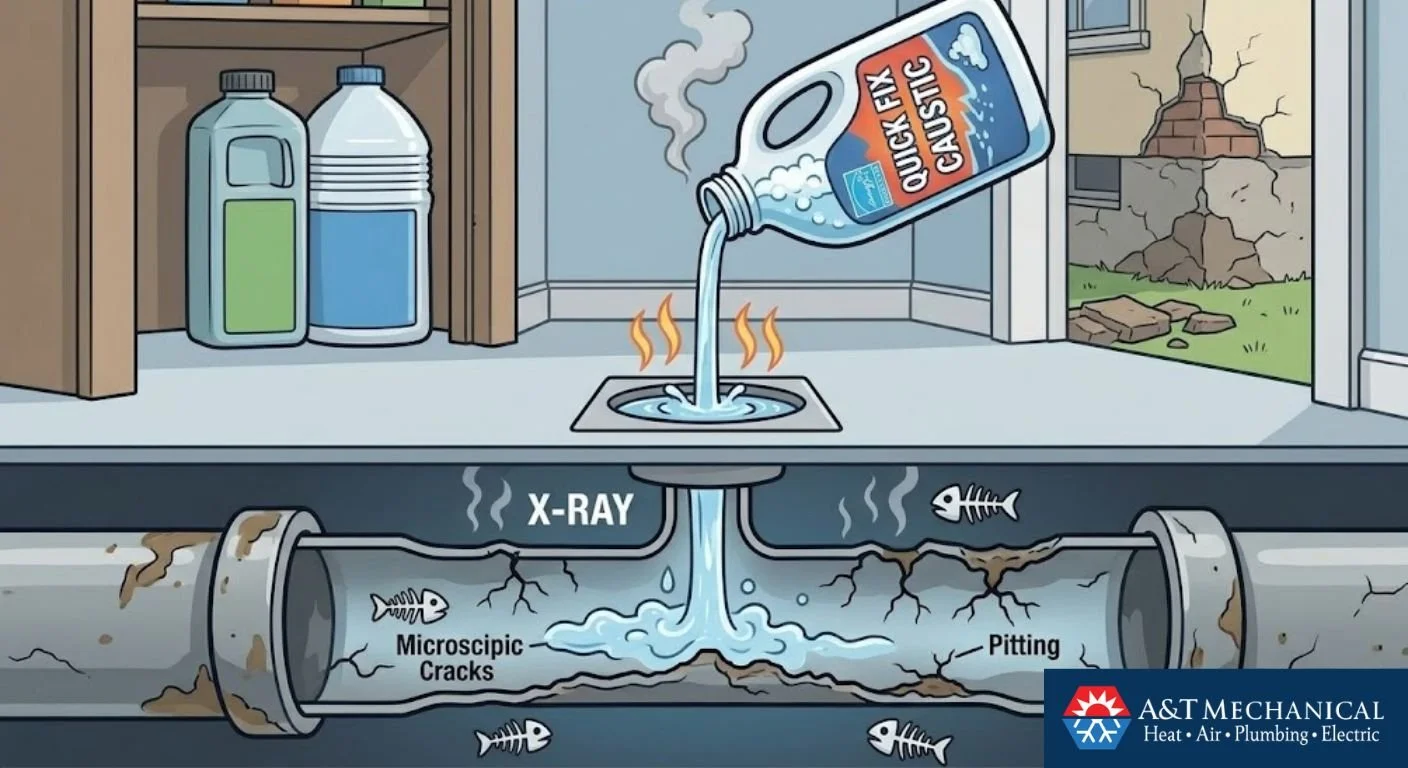
Most chemical drain cleaners work by triggering a highly caustic chemical reaction inside your pipe. That reaction generates heat, sometimes significant heat, designed to dissolve organic material like hair and grease. The problem is that the same reaction that breaks down the clog also attacks the pipe material itself.
Older pipes made of galvanized steel or cast iron are particularly vulnerable to this chemical assault. But even PVC pipes, which are more resistant, can soften and warp under repeated exposure to caustic chemicals. Over time, chemical drain cleaners that are used frequently don't just clean your pipes. They thin the pipe walls, weaken joints, and accelerate the deterioration that leads to leaks and failures.
What Liquid Cleaners Actually Do vs. What They Claim
Chemical drain cleaners are effective at clearing soft, fresh organic clogs near the drain opening. But they rarely penetrate deep enough to address buildup further down the line, and they're completely ineffective against mineral scale, tree root intrusions, grease buildup that has hardened deep in the pipe, or physical obstructions. So what you often get is a temporary improvement in drainage that gives you a false sense of security, while the underlying problem continues to develop untouched.
The right solution for any clog that goes beyond a surface-level, fresh blockage is professional intervention with the right tools.
Professional Drain Cleaning Methods That Actually Work
Professional plumbing Edmond OK technicians have access to tools and techniques that no amount of store-bought products can replicate. These methods don't just temporarily improve drainage. They restore your pipes to their proper condition.
Hydrojetting: The Power Wash Your Pipes Deserve
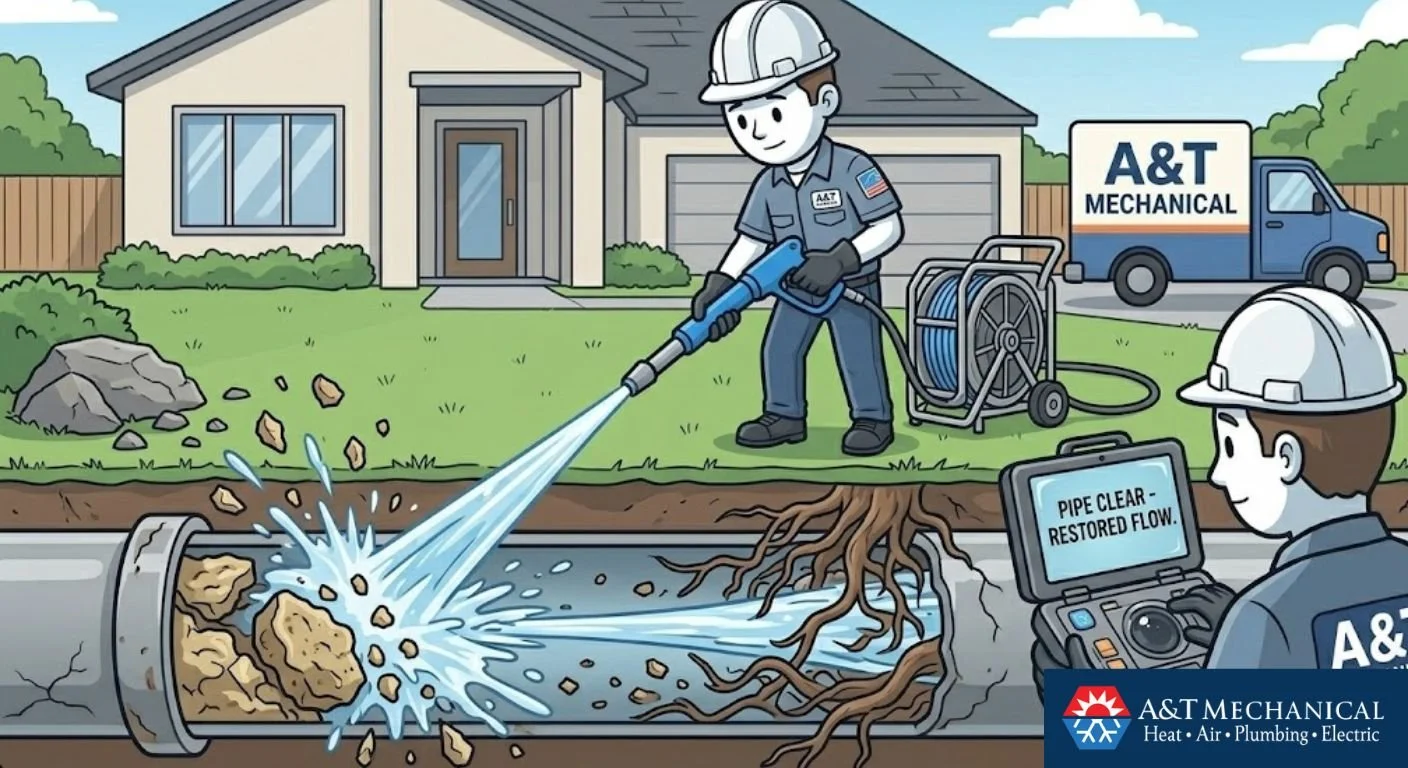
Hydrojetting is one of the most effective drain cleaning methods available to professionals. It works by propelling a highly pressurized stream of water through the pipe, typically at pressures ranging from 1,500 to 4,000 PSI, depending on the pipe type and severity of the blockage. That jet of water doesn't just push the clog further down the pipe. It blasts it apart, scours the pipe walls clean, and flushes the resulting debris completely out of the system.
Hydrojetting is particularly effective for grease buildup, mineral scale, and recurring clogs that chemical cleaners have failed to resolve. After hydrojetting, the interior of your pipe is as clean as it can reasonably be, which means slower buildup going forward and better overall drainage performance.
Drain Snaking: Targeted and Effective
A drain snake, also called an auger, is a flexible cable with an attachment at the end designed to break apart or retrieve physical blockages. Professional-grade electric drain snakes are far more powerful and precise than the manual versions sold at hardware stores. They can reach deep into your plumbing system to address clogs that are well beyond the reach of any consumer tool.
Drain snaking is ideal for soft, physical clogs like hair masses, grease accumulations, and foreign object obstructions. A skilled plumbing Edmond OK technician will select the right snake size and attachment for the specific type of pipe and clog they're dealing with, ensuring effective clearance without damaging the pipe.
Camera Inspections: Seeing the Problem Before Solving It
One of the most valuable tools in a professional drain cleaning toolkit is the pipe camera. A small, waterproof camera mounted on a flexible cable is fed into the drain line, transmitting live video of the pipe interior to a monitor the technician can view in real time.
Camera inspections allow technicians to see exactly what's causing a blockage, where it's located, and what condition the surrounding pipe is in. This eliminates guesswork entirely. Instead of treating a symptom without knowing the cause, a camera inspection provides a definitive diagnosis that guides the most effective treatment. It also reveals other issues inside the pipe, like cracks, corrosion, root intrusions, or collapsed sections, that wouldn't be detectable any other way.
How Often Should You Schedule Professional Drain Cleaning?
Professional drain cleaning isn't just a fix for when things go wrong. It's also a proactive maintenance strategy that prevents serious problems from developing in the first place.
For most Edmond OK, households, an annual professional drain cleaning is an excellent baseline. Homes with older plumbing, high occupancy, or known hard water issues may benefit from semi-annual service. Kitchen drains in homes where cooking with oils and fats is common should be inspected and cleaned more frequently than average.
The best way to determine the right schedule for your specific home is to have a professional assessment done. A qualified plumbing Edmond OK technician can evaluate the age and condition of your pipes, identify any existing buildup or concerns, and recommend a maintenance interval that makes sense for your household's habits and your plumbing system's needs.
Why A&T Mechanical Heat&Air Services, Inc. Is Edmond OK's Go-To Plumbing Team
When drain cleaning and plumbing issues arise in Edmond OK, homeowners want a team they can trust to show up, diagnose accurately, and deliver lasting results. That's exactly what A&T Mechanical Heat&Air Services, Inc. provides.
A Commitment to Honest, Lasting Solutions
What sets A&T Mechanical Heat&Air Services, Inc. apart isn't just their technical skill, though that's substantial. It's their commitment to honesty and transparency in everything they do. They don't recommend services you don't need. They explain what they find, what it means, and what your options are, in plain language that empowers you to make informed decisions about your home.
When A&T Mechanical Heat&Air Services, Inc. clears a drain, they're not just restoring flow for today. They're identifying the root cause, assessing the surrounding pipe condition, and ensuring that their solution addresses the actual problem rather than just the symptom.
Serving Edmond OK Homeowners with Expertise and Care
A&T Mechanical Heat&Air Services, Inc. has earned the trust of Edmond OK, homeowners through consistent, high-quality plumbing Edmond OK service delivered with genuine care for each client's home and family. Their technicians are trained, experienced, and equipped with professional-grade tools that make a real difference in the quality and durability of their work.
Whether you're dealing with a slow kitchen drain, a backed-up bathroom, a recurring clog that chemicals can't seem to fix, or a full sewer line issue, the team at A&T Mechanical Heat&Air Services, Inc. has the expertise and equipment to resolve it completely.
A&T Mechanical Heat & Air Services, Inc. Proudly Serving Vintage Gardens and Surrounding Areas in Edmond, Oklahoma
A&T Mechanical Heat&Air Services, Inc. is committed to supporting the residents of Vintage Gardens. Our location is conveniently situated near The Vintages At Camden Park, close to the intersection of NW 158th Street and Lacebark Lane (coordinates: 35.6355341299027, -97.53831958224507), making it easy for locals to access our Plumbing Edmond OK.
Trusted Plumbing Services in Vintage Gardens You Can Rely On
Call or contact us to learn more.
Directions from Vintage Gardens to A&T Mechanical Heat & Air Services, Inc.
Conclusion
A clogged drain isn't a small problem that you can afford to keep putting off. It's a signal from your plumbing system that something isn't working the way it should, and the longer that signal is ignored or temporarily masked with chemical cleaners, the more serious the consequences become. From pipe damage and mold growth to sewage backup and structural harm, the stakes of neglected drain problems are real, significant, and entirely avoidable with the right professional support.
In Edmond OK, A&T Mechanical Heat&Air Services, Inc. is the plumbing Edmond OK team that homeowners turn to when they want honest assessments, effective solutions, and work that's done right the first time. Don't wait for a slow drain to become a plumbing emergency. Reach out to A&T Mechanical Heat&Air Services, Inc. today and give your home's plumbing the professional attention it deserves.
FAQs
1. Is a slow drain always a sign of a clog, or could something else be causing it?
A slow drain is most commonly caused by a buildup clog somewhere in the drain line, but other factors can contribute as well. Venting problems in your plumbing system, which allow air to flow through pipes to enable proper drainage, can cause slow draining even without a physical clog. Pipe deterioration, partial collapses, and root intrusions can also restrict flow. A professional camera inspection is the most reliable way to identify the exact cause and avoid treating the wrong problem.
2. Can I use a plunger instead of calling a professional for a clogged drain?
A plunger is a perfectly reasonable first step for fresh, surface-level clogs in toilets and single drains. If a few attempts with a plunger don't resolve the issue, or if multiple drains in your home are slow simultaneously, the problem is likely deeper in the system and requires professional tools to address properly. Using a plunger on a severely compacted or deep clog can sometimes make things worse by pushing the blockage further into the pipe.
3. How do I know if my main sewer line is clogged versus a single drain line?
The clearest sign of a main sewer line clog versus a localized single-drain clog is the behavior of multiple fixtures simultaneously. If you flush the toilet and water backs up into the shower, or if running the washing machine causes toilets to gurgle or overflow, your main sewer line is almost certainly involved. A single slow drain that doesn't affect any other fixture is more likely a localized issue. Either way, a professional assessment is the right next step.
4. Are there any steps I can take at home to prevent drain clogs between professional cleanings?
Yes, several habits make a meaningful difference. Use drain screens or hair catchers in all bathroom drains and clean them regularly. Never pour cooking grease or oil down the kitchen sink, even when mixed with hot water or dish soap. Run hot water down the kitchen drain for 30 to 60 seconds after each use to help flush residual grease. Avoid flushing anything other than toilet paper down the toilet, regardless of how a product is labeled. And schedule regular professional drain cleaning to address buildup before it becomes a blockage.
5. How long does a professional drain cleaning service typically take?
The duration depends on the severity and location of the clog as well as the method used. A straightforward drain snaking of a single fixture typically takes less than an hour. Hydrojetting a main sewer line or addressing a complex multi-drain issue may take two to three hours. If a camera inspection is included, add additional time for a thorough pipe assessment and review of findings. Your plumbing Edmond OK technician will give you a realistic time estimate before beginning work so you can plan accordingly.
Written by A&T Mechanical Heat&Air Services, Inc. | Updated May 2026