
Do You Need a Permit for Electrical Panel Replacement in Edmond OK?
It's one of the most common questions homeowners ask when they find out their electrical panel needs to be replaced: do we actually need a permit for this? Sometimes the question comes from genuine curiosity. Sometimes it comes after a contractor casually suggests that skipping the permit would save money and speed things up. And occasionally, it comes after unpermitted work has already been done and a homeowner is now dealing with the consequences.
Let's answer the question directly and completely: yes, electrical panel replacement Edmond requires a permit. Full stop. And the reasons that requirement exists matter a great deal to your safety, your insurance coverage, your home's value, and your legal standing as a property owner.
This guide walks through everything you need to know about the permit process for electrical panel replacement in Edmond OK, who handles it, what it involves, what it protects you from, and how working with the right licensed professional makes the entire process simple and straightforward.
The Permit Question Most Homeowners Skip Until It's Too Late
Permits are among the least glamorous aspects of home improvement. They don't make your home look better or feel more comfortable. They don't come with a warranty or a satisfaction guarantee. They're a process requirement, a bureaucratic step that most homeowners would prefer to skip if they could.
Why Permits Exist and Who They Actually Protect
Building permits exist because certain types of work on a home, electrical systems, structural modifications, plumbing changes, carry safety risks that aren't self-regulating. Left entirely to market forces, some contractors would cut corners. Some would make mistakes without accountability. Some would install systems that meet no defined safety standards, leaving homeowners exposed to hazards they couldn't detect.
The permit system creates accountability at multiple levels. It requires that the work be done by a qualified, licensed contractor. It creates a documented record of what was done and when. And it triggers a mandatory inspection by a certified building official who verifies that the work meets code requirements before the project is considered complete.
In short, permits protect you, not the contractor. Not the municipality. You.
Why This Question Matters Before Work Begins, Not After
If unpermitted electrical panel work has already been completed in your home, the permit question is no longer hypothetical. It's a real problem with real consequences that don't disappear just because the work is done and the panel is functioning. Retroactively addressing unpermitted work is possible but involves costs, complications, and potential remediation requirements that could have been entirely avoided by doing it correctly from the start.
The right time to ask about permits for electrical panel replacement Edmond is before any contractor touches your panel. A clear understanding of the requirement, who handles it, and what it involves protects you from making a decision you'll regret later.
The Short Answer: Yes, You Need a Permit for Electrical Panel Replacement Edmond
Some types of electrical work, like replacing a light fixture or swapping a standard outlet, may not require permits in many jurisdictions. Electrical panel replacement is not in that category. It's one of the most consistently permit-required projects across virtually every jurisdiction in Oklahoma and the country.
What Oklahoma and Local Code Requires
The Oklahoma Uniform Building Code and local amendments require permits for all electrical work that involves the service equipment of a residential structure. The main electrical panel, also called the load center or service panel, is by definition service equipment. Any replacement of, modification to, or upgrade of the main service panel falls squarely within the permit requirement.
This requirement exists at both the state code level and the local level, and local jurisdictions may have additional requirements on top of the state baseline. For electrical panel replacement Edmond specifically, the local authority having jurisdiction (AHJ) administers the permit process and conducts the required inspection. The exact fee structure, timeline, and inspection scheduling process is managed at that local level.
Why Panel Work Is Specifically Flagged for Permit Requirements
Electrical panel work is among the most specifically regulated residential projects for a straightforward reason: the panel is the point where the utility's high-voltage service connection meets your home's distribution system. Even with the main breaker turned off, the service entrance conductors feeding the panel remain energized at full utility voltage. This is a condition that most homeowners don't know and that creates serious injury and fatality risk when work is done by unqualified individuals without proper oversight.
The permit requirement for panel replacement ensures that only licensed contractors are doing this work, that the work is inspected by a qualified official, and that a formal record exists confirming the installation meets safety standards. Given the stakes involved, this layer of regulatory oversight is entirely appropriate.
The Difference Between a Permit and an Inspection
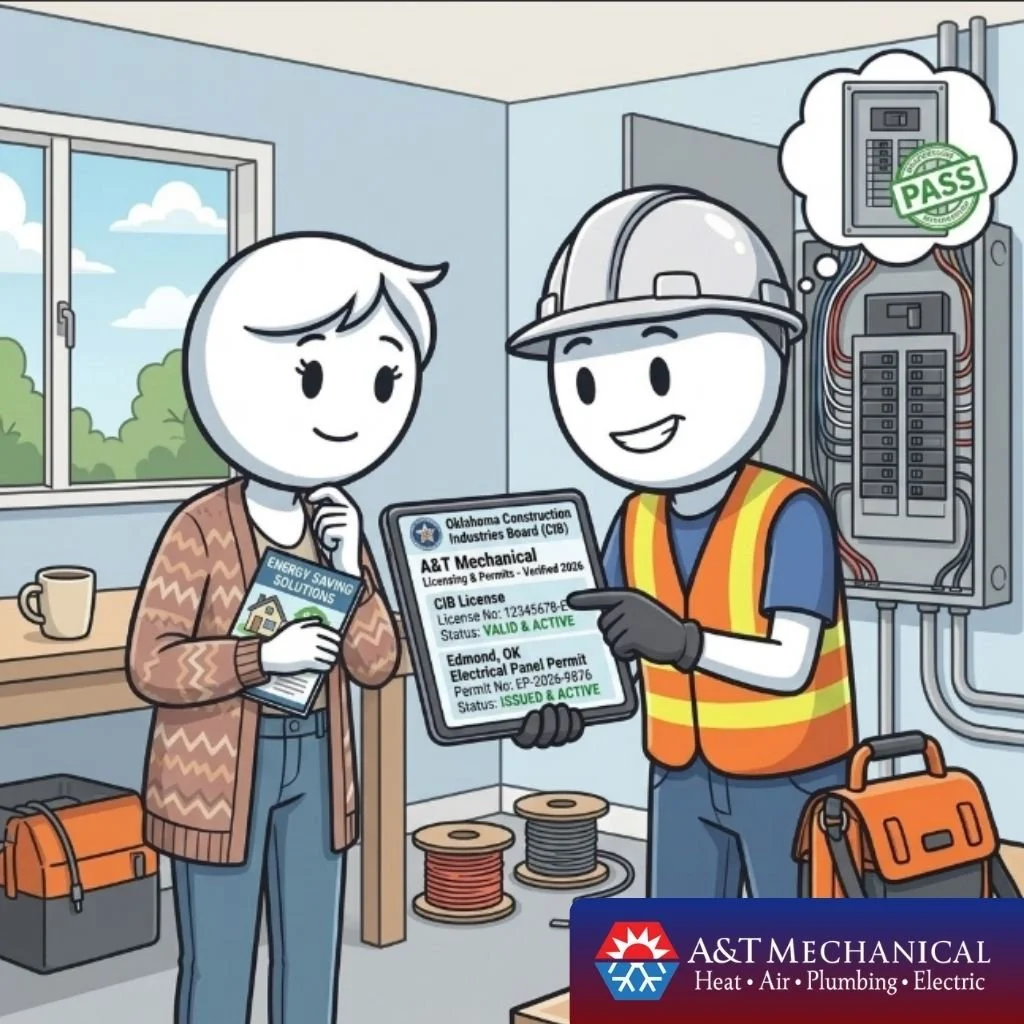
These two terms are related but distinct. A permit is the official authorization to perform the work. You (or more typically, your contractor) apply for the permit before work begins, paying the associated fee. The permit is issued based on the scope of work described in the application.
An inspection is the follow-up verification step that happens after the work is complete. A building official visits the site, examines the installation, and either approves it (passing the inspection and closing out the permit) or identifies deficiencies that need to be corrected before approval is granted. Both steps, the permit and the inspection, are required for the project to be legally complete. You can't just pull a permit and skip the inspection, or vice versa.
Who Is Responsible for Pulling the Permit?
This is where many homeowners have misconceptions that can create problems if not clarified upfront.
The Contractor's Role in the Permit Process
In standard practice for residential electrical panel replacement, the licensed contractor pulls the permit on behalf of the homeowner. This is the normal, expected process and the one that a fully licensed and legitimate electrical contractor will follow without hesitation.
The contractor handles the permit application, provides the required project details to the building department, pays the permit fee (which is then typically passed through to the homeowner as part of the project cost), and schedules the inspection once the work is complete. The contractor's license is part of what enables them to pull permits for this type of work.
When you hire a licensed contractor for electrical panel replacement Edmond, the permit process should be a seamless, included part of the service rather than an optional add-on or an afterthought. If a contractor presents the permit as something separate, optional, or not their responsibility, that's a red flag worth taking seriously.
What It Means When a Contractor Offers to Skip the Permit
This situation comes up more often than homeowners might expect. A contractor quotes a lower price and mentions, casually or directly, that the price can be further reduced if they skip the permit. Sometimes it's framed as saving you money. Sometimes it's framed as saving time. Sometimes it's framed as something that "everyone does" for this kind of work.
None of those framings are accurate, and the suggestion itself is a disqualifying red flag. A contractor who proposes skipping permits is proposing to expose you to insurance risk, legal liability, and resale complications in exchange for saving themselves the time and accountability that the permit process creates. They're not saving you money. They're transferring significant risk onto you while reducing their own accountability.
A licensed, professional electrical contractor who takes pride in their work wants the inspection. It validates the quality of their installation. Contractors who avoid inspections are often avoiding the accountability that inspections provide.
What the Permit and Inspection Process Looks Like Step by Step
Understanding the actual process makes it feel less abstract and helps homeowners know what to expect from a properly managed electrical panel replacement Edmond project.
From Application to Final Approval
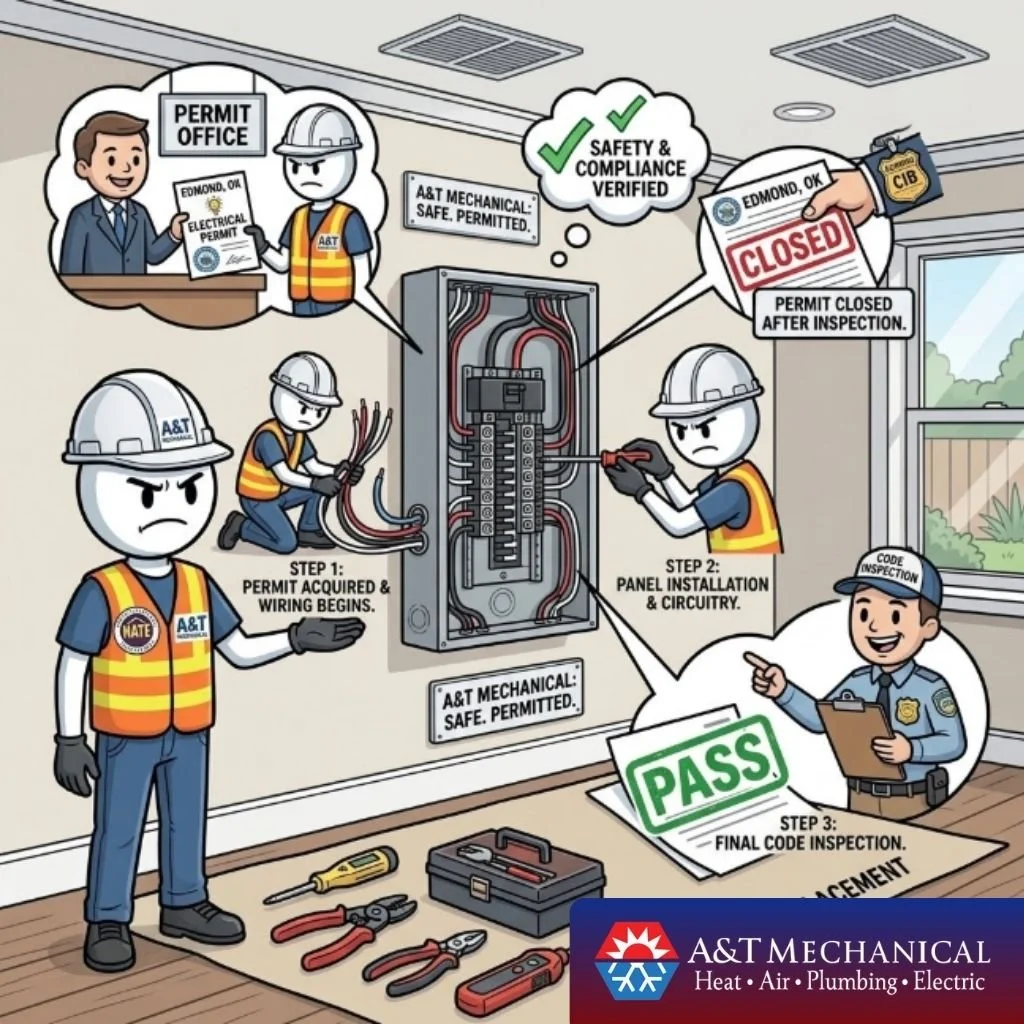
The process begins when your contractor submits the permit application to the local building department. The application describes the scope of work: specifically that it involves electrical service panel replacement, the panel's new amperage rating, and the address of the property. In most cases for residential electrical work, permits are issued quickly, often same-day or within one to two business days.
With the permit issued, the contractor schedules the installation. The work is performed, typically in a single day for a standard residential panel replacement. At this point, the panel is installed, and the home has power, but the permit is not yet closed out because the inspection hasn't occurred.
The contractor requests an inspection from the building department. An inspector is scheduled, typically within one to three business days of the request. The inspector visits the property, examines the installation, and either approves it or notes deficiencies requiring correction. Once the inspection passes, the permit is formally closed and the project is officially, legally complete.
What the Inspector Looks for During a Panel Inspection
A licensed building inspector evaluating an electrical panel replacement Edmond installation is looking at a specific set of code compliance items. The inspection covers the physical installation of the panel enclosure, verifying that it's properly mounted, grounded, and bonded. Inspectors check that all circuits are properly identified, that wiring connections are made correctly to appropriately sized breakers, and that the panel's amperage rating is appropriate for the service entrance conductors.
They verify that arc-fault circuit interrupter (AFCI) protection and ground-fault circuit interrupter (GFCI) protection are installed on the circuits that require them under current code. They check that the working clearances around the panel meet code requirements. They confirm that the service entrance and meter base configuration is appropriate for the new panel capacity. And they verify that the work was performed by a licensed contractor, which is confirmed through the permit documentation.
What Happens If the Work Fails Inspection
Failing an inspection is not a catastrophic outcome, though it does add time and potentially cost to the project. If the inspector identifies deficiencies, the contractor is given an itemized list of what needs to be corrected. The contractor makes the corrections, and a re-inspection is scheduled. Most inspection failures on professional work involve minor items that are corrected quickly.
The key point is that this process works the way it's designed to: the inspection catches any mistakes before they become embedded in your home's electrical system for years. A failed-then-passed inspection is, in this sense, the permit system doing exactly what it's supposed to do. And a contractor who pulls permits regularly and has their installations inspected consistently knows what inspectors look for and installs accordingly.
The Consequences of Skipping the Permit for Electrical Panel Replacement Edmond
If the permit requirement sounds like a formality, a brief look at what happens when it's ignored typically reframes that assessment quickly.
Insurance Coverage Risks You Can't Afford to Ignore
Your homeowner's insurance policy contains provisions requiring that covered structures meet applicable building codes and that work on the property comply with local regulations. An electrical panel installation performed without the required permit is, by definition, not in compliance with local regulations.
When a loss occurs that's related to or traceable to an unpermitted electrical installation, whether that's an electrical fire, an electrical fault that causes equipment damage, or a related water damage event from a failed suppression system, your insurer has grounds to deny the claim based on the non-compliant work. In practice, adjusters investigate significant claims, and unpermitted electrical work discovered during that investigation creates the basis for a denial.
The financial stakes of a denied claim on a significant home fire or major electrical damage event are enormous. The cost of the permit itself is trivial by comparison.
What Unpermitted Work Does to Your Home's Resale Value
When you sell your home, the buyer's agent will typically request documentation of all significant work performed on the property and the associated permits. A buyer's home inspector who discovers a newer electrical panel with no permit on record will flag it in their report. This creates several possible outcomes, none of them ideal for the seller.
The buyer may request that the unpermitted work be retroactively permitted and inspected before closing. Retroactive permitting requires the building department to be notified of the existing unpermitted work, an inspection to be scheduled, and any deficiencies identified during inspection to be corrected before approval. This process introduces uncertainty about the timeline and cost of corrections.
Alternatively, the buyer may use the unpermitted work as a negotiating point to reduce the purchase price. Or in a cautious buyer's case, they may simply walk away from the transaction entirely. What should be a straightforward sale becomes a complicated negotiation over a problem that never needed to exist.
Legal and Financial Liability You May Not Know You're Taking On
Beyond insurance and resale complications, there are more direct legal consequences to unpermitted work. Municipalities have the authority to require that unpermitted work be corrected or removed. If unpermitted work is discovered during a routine building inspection triggered by another project, during a neighbor dispute, or during a code enforcement action, you could be required to bring the work into compliance at your own expense regardless of when it was done.
If unpermitted electrical work contributes to an injury or fatality in your home, whether that's a fire that injures a household member or an electrical fault that harms a visitor, the absence of the required permit becomes a significant factor in any subsequent legal proceeding. The permit and inspection process exists to prevent exactly those outcomes. Skipping it doesn't just create technical non-compliance. It creates a gap in the accountability chain that can expose you to liability.
How Long Does the Permit Process Take?
One of the most common objections to the permit process is that it adds time to the project. Let's put that concern in accurate perspective.
Realistic Timelines for Edmond OK Panel Replacement Projects
The permit application for a standard residential electrical panel replacement is typically processed by the local building department within one to two business days. In many cases, permits for straightforward residential electrical work are issued on the same day as the application. This means that a well-planned electrical panel replacement Edmond project can have the permit in hand the day before or the day of the scheduled installation.
Post-installation inspection scheduling typically involves a wait of one to three business days from the time the inspection request is submitted. The total elapsed time from permit application to final inspection approval for a standard residential panel replacement is commonly five to ten calendar days from start to finish.
In the context of a project that will affect the safety of your home for the next 20 to 25 years, a week-long permit and inspection process is not a material inconvenience. It's a proportionate investment in doing the job correctly.
How to Avoid Unnecessary Delays
The most common source of permit-related delays is waiting until the last minute. A professional contractor who schedules panel replacement work efficiently submits the permit application before the installation date is locked in, ensuring that the permit is issued and ready before the crew arrives. This parallel processing approach eliminates any waiting period for the homeowner.
Post-installation inspection delays are minimized when the contractor requests the inspection immediately upon completion rather than waiting. A contractor who is organized, professional, and accustomed to the permit process treats these logistics as a standard part of the job, not an afterthought.
Does a Permit Cost Extra and Is It Worth It?
Permit fees for electrical panel replacement are real costs that appear on your project invoice, but they need to be understood in proper context.
What Permit Fees Look Like for Panel Work
Electrical permit fees are set by the local jurisdiction and vary by the scope of work. For a residential electrical panel replacement, permit fees typically range from approximately $50 to $200 depending on the panel size and the specific fee schedule in effect. This is a modest expense relative to the total cost of a panel replacement project, which commonly runs $1,500 to $3,000 or more.
A legitimate contractor includes the permit fee in their project estimate as a line item, making it transparent and accountable. Homeowners should be able to see exactly what the permit costs and verify that it's included in the project scope.
The Real Return on Investment of a Properly Permitted Installation
The permit fee isn't really a cost in the traditional sense of the word. It's a payment for accountability, legal compliance, insurance protection, and the official confirmation that your home's most critical electrical component was installed correctly and inspected by a qualified authority.
Consider what you're actually getting for that permit fee: a formal record that protects your insurance coverage, documentation that strengthens your home's resale position, official confirmation that the work meets current safety codes, and the peace of mind of knowing that an independent professional has verified the installation. That's substantial value for a modest fee.
How A&T Mechanical Heat&Air Services, Inc. Handles the Entire Permit Process
For homeowners considering electrical panel replacement Edmond, the permit process is one of the clearest indicators of whether a contractor is operating as a professional partner or a risk-transfer mechanism.
Why Choosing a Fully Licensed Contractor Simplifies Everything
When you hire a licensed electrical contractor, the permit process becomes their responsibility rather than yours. You don't navigate the building department. You don't research the fee schedule. You don't schedule the inspection. A professional contractor handles all of it as a natural, included part of the project scope.
This is precisely how A&T Mechanical Heat&Air Services, Inc. operates. As a licensed contractor with a strong record of professional, code-compliant work, they pull the required permits for every applicable project, coordinate with the building department, and schedule and manage the inspection process from start to finish. Homeowners aren't left to figure out bureaucratic processes on their own, and they're never put in the position of unknowingly authorizing work that leaves them legally exposed.
What Homeowners Experience When the Process Is Done Right
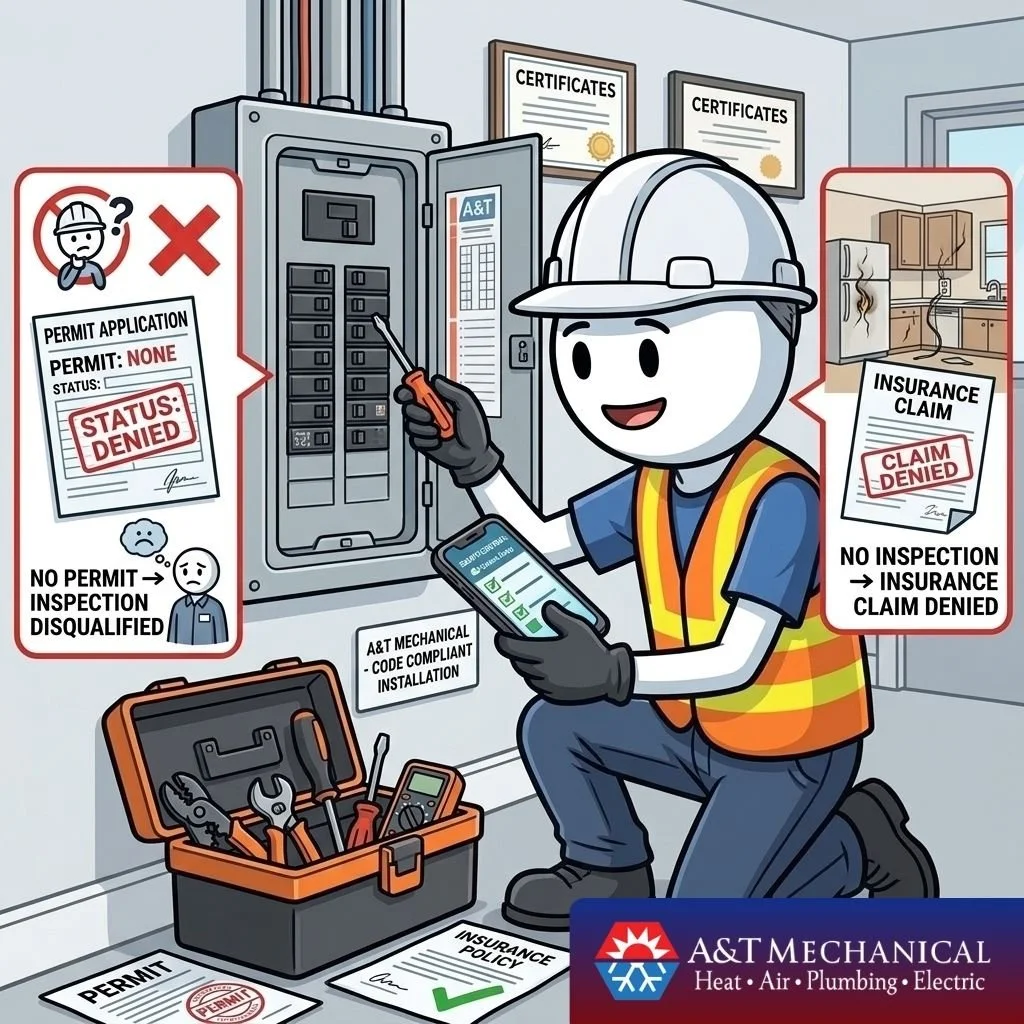
When A&T Mechanical Heat&Air Services, Inc. handles an electrical panel replacement Edmond project, homeowners experience exactly what a well-managed professional project should feel like: clear communication upfront about the scope and process, transparent project pricing that includes permit fees, installation completed by licensed and skilled technicians, and a passed inspection that officially confirms the work meets every applicable code requirement.
There are no surprises when the home is listed for sale. No complications when a damage claim needs to be filed. No anxiety about whether the most critical electrical component in the home was installed correctly. That's the real value of working with a contractor who treats permits and inspections as non-negotiable professional standards rather than optional overhead.
A&T Mechanical Heat & Air Services, Inc. Proudly Serving Brasswood and Surrounding Areas in Edmond, Oklahoma
A&T Mechanical Heat&Air Services, Inc. is committed to supporting the residents of Brasswood. Our location is conveniently situated near Oknoname 25 Lake, close to the intersection of NW 148th Street and Brasswood Parkway (coordinates: 35.621891813091416, -97.54059999419835), making it easy for locals to access our Electrical panel replacement Edmond.
Trusted Electrical Panel Replacement Services in Brasswood You Can Rely On
Call or contact us to learn more.
Directions from Brasswood to A&T Mechanical Heat & Air Services, Inc.
Conclusion
The answer to whether you need a permit for electrical panel replacement Edmond is clearly and definitively yes. The permit requirement exists to protect you: your safety, your insurance coverage, your home's market value, and your legal standing as a property owner. It's not optional. It's not something that "everyone skips." And it's not a meaningful complication when you work with a licensed, professional contractor who handles it as a standard part of the job.
The contractors who suggest skipping permits are protecting their own time and accountability, not yours. The contractors who pull permits without being asked are demonstrating professional integrity that extends throughout every aspect of their work.
A&T Mechanical Heat&Air Services, Inc. is the electrical panel replacement Edmond team that handles every project with the thoroughness, licensing, and professional commitment that homeowners deserve. Reach out today for an honest assessment of your panel and a clear, complete project plan that includes everything necessary to do the job right.
FAQs
1. Can I pull the permit myself as a homeowner for electrical panel replacement?
In some jurisdictions, homeowners are legally permitted to pull permits for work done on their own primary residence. However, this option comes with significant caveats. The permit for electrical panel replacement Edmond typically requires the contractor's license information as part of the application, and the inspection process is designed to verify code-compliant work by a licensed professional. If a homeowner pulls the permit and hires an unlicensed contractor to do the actual work, the permit provides little of the protection it's designed to offer. The most straightforward and protective approach is to hire a licensed contractor who pulls the permit as part of their scope.
2. What happens to my existing unpermitted panel installation if I want to sell my home?
You have a few options when unpermitted electrical panel work surfaces during the sale process. You can apply for a retroactive permit, have the work inspected, and address any deficiencies identified during inspection before the sale. You can disclose the unpermitted work and negotiate the sale price accordingly. Or in some cases, the work may need to be redone entirely to meet current code before a permit can be issued. Consulting with a licensed electrician and a real estate attorney about the specifics of your situation is the appropriate first step. None of these paths is as clean or cost-effective as having the permit pulled correctly in the first place.
3. Does the inspection happen while the work is being done or after?
For electrical panel replacement, the inspection occurs after the installation is complete and the system has been energized. The inspector examines the finished installation rather than observing the work in progress. This is the standard process for residential electrical panel work. The inspector is looking at the completed installation and verifying that all aspects of it meet current code requirements. Some jurisdictions may require a rough-in inspection at certain stages of complex projects, but for standard panel replacements, the single post-installation inspection is the norm.
4. If my panel replacement passes inspection, does that mean I have no further concerns about it?
A passed inspection confirms that the installation meets current code requirements at the time of inspection. It's a meaningful baseline that protects you legally and provides insurance documentation. However, a passed inspection doesn't substitute for ongoing maintenance. Annual professional assessment of the panel by a licensed electrician ensures that connections remain tight, components remain in good condition, and any emerging issues are identified before they develop into problems. A passed inspection is the starting line for a well-maintained electrical system, not the finish line.
5. How does a permit affect my homeowner's insurance coverage for the panel replacement?
A properly permitted and inspected panel replacement strengthens your insurance position in several ways. It confirms that the work meets code standards, which satisfies policy requirements for covered structures to comply with applicable building regulations. It creates an official record of the installation that supports any future claim involving electrical systems. And it eliminates the "unpermitted work" basis that insurance companies use to deny claims related to electrical systems. Inform your insurance carrier after a major electrical upgrade, including a panel replacement, to ensure your coverage reflects the improved condition of your home's electrical system and potentially benefit from premium adjustments.
Written by A&T Mechanical Heat&Air Services, Inc. | Updated June 2026