
HVAC Contractor vs. Home Warranty Company in Edmond OK: Which Should You Call First?
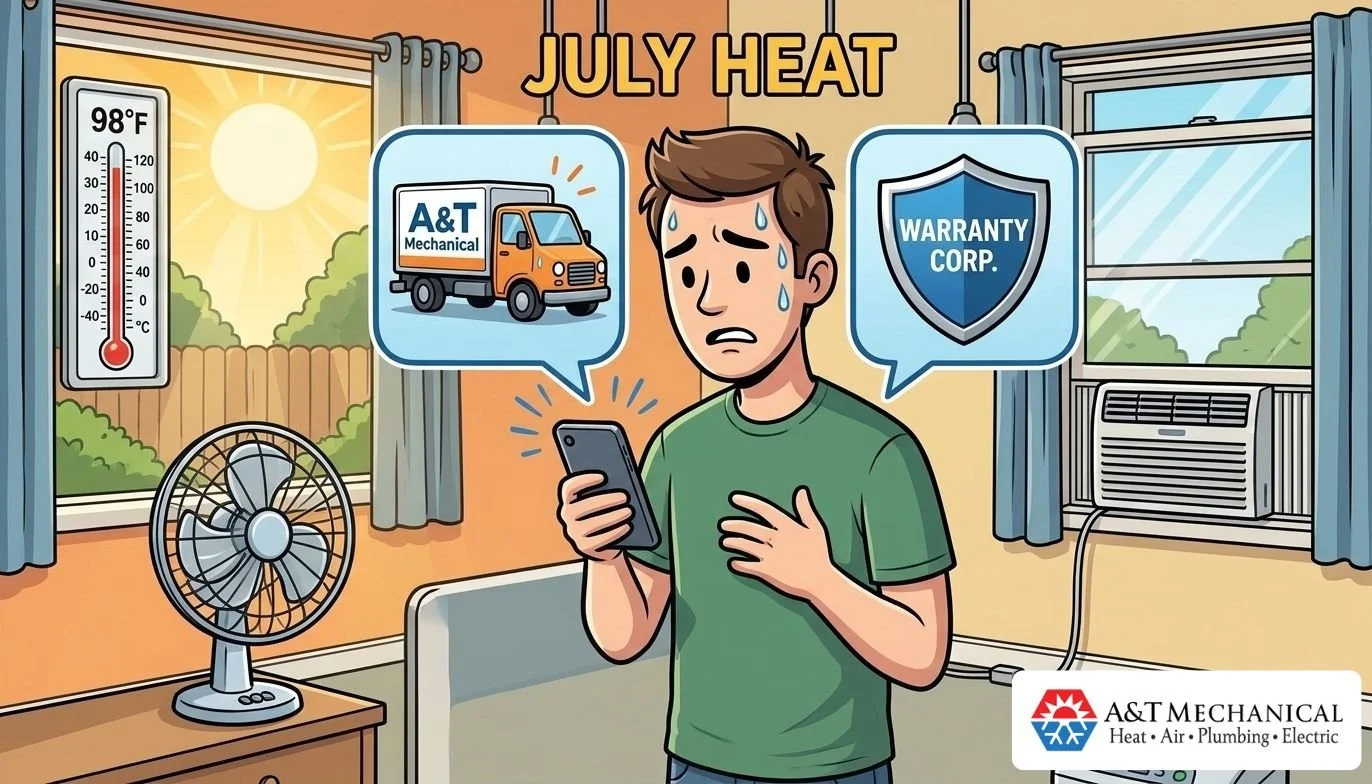
Your air conditioner stops working on a Thursday afternoon in July. The temperature inside is already climbing. You have two numbers in front of you: your home warranty company's claims line and your trusted HVAC contractor Edmond OK. You know the home warranty might cover the repair, but you also know it might take days to get anyone out. Which call do you make first?
This is a real decision with real financial and comfort consequences, and most homeowners in Edmond OK make it without enough information. Some call the warranty company first out of habit and end up waiting four days in July heat while the claims process crawls forward. Others call a contractor immediately, pay out of pocket, and discover they could have been partially reimbursed.
Neither choice is universally correct. The right answer depends on the nature of the problem, the specifics of your warranty coverage, the time of year, and what you know about your contractor. This guide lays out the full picture so that the next time this decision lands in your lap, you'll know exactly what to do.
The Question Every Edmond OK Homeowner Faces
Home warranties have become increasingly common, marketed as a safety net for unexpected failures of home systems. On paper, HVAC coverage sounds excellent: one of the most expensive systems in your home, covered against breakdown for an annual premium and a per-call service fee. Many homeowners purchase these plans feeling genuinely protected.
Then the system fails, and the reality of how home warranty companies operate becomes apparent.
Why This Decision Matters More During a Heat Wave
Edmond OK, summer heat is not a background inconvenience. Triple-digit temperatures for days at a stretch make a failed AC system a genuine health and safety issue for elderly residents, young children, people with health conditions, and pets. The abstract question of "should I call the warranty company or my contractor first?" becomes very concrete when the indoor temperature is approaching 90 degrees and rising.
In time-sensitive situations, the speed of response is not a secondary consideration. It's the primary one. A repair that takes two days costs the same as a repair that takes four days, but the additional two days of heat exposure creates risks that money can't retroactively address. Understanding when speed must take priority over potential coverage reimbursement is the core of this decision.
The Fundamental Tension Between Speed and Coverage
The structural tension in this decision is straightforward. Home warranty companies offer the possibility of financial coverage, but they control the process, the timeline, and the contractor assigned to your claim. You trade speed and contractor choice for the potential offset of repair costs.
Calling your preferred HVAC contractor Edmond OK directly gives you speed, the ability to work with a contractor whose quality and integrity you trust, and typically a faster resolution. You accept the financial risk that the repair won't be covered and you'll pay out of pocket.
Neither approach is objectively superior in every situation. What determines the right choice is a clear understanding of what each path actually delivers.
How Home Warranty HVAC Coverage Actually Works
Most homeowners who purchase home warranty plans don't read the coverage documents in detail until they need to file a claim. That's when the gaps and conditions that seemed like fine print become consequential realities.
The Claims Process Most Homeowners Underestimate
When an HVAC system fails, the home warranty claims process begins with a call to the warranty company's customer service line. The homeowner describes the problem, a claim is opened, and the warranty company dispatches one of their contracted service providers to perform a diagnostic. This first visit is not a repair visit. It's a diagnostic visit to assess the problem.
The diagnostic technician assesses the issue and submits a report to the warranty company. The warranty company then reviews the report and makes a coverage decision. If covered, they authorize the repair and schedule the contractor to return with the required parts. If the repair requires ordering parts, that adds additional days to the timeline.
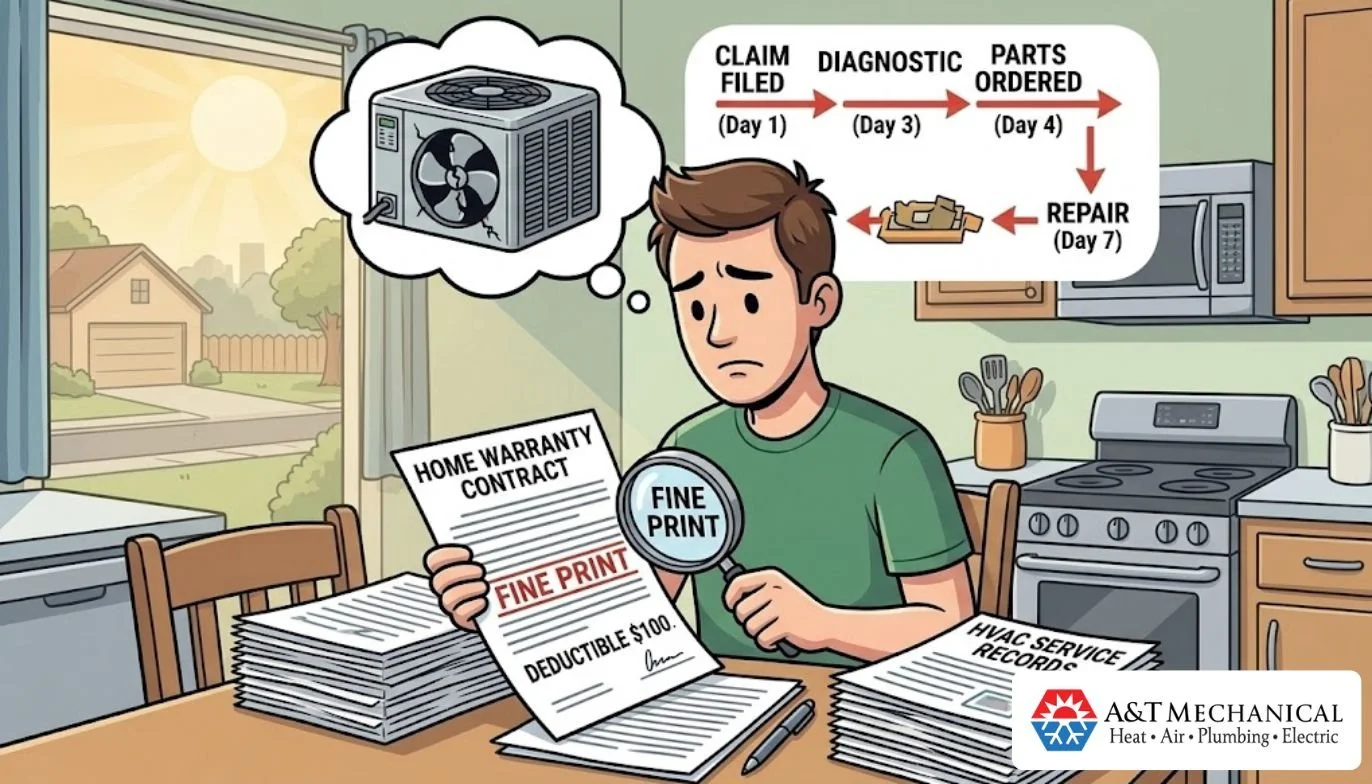
From initial call to completed repair, the total elapsed time for a home warranty HVAC claim commonly runs from three to seven days, and sometimes longer during peak summer demand when warranty contractors are managing multiple claims simultaneously. In Edmond OK's July heat, a week without functioning air conditioning is a significant hardship.
What Home Warranties Typically Cover and What They Don't
Standard home warranty HVAC coverage typically includes mechanical failures of major components: the compressor, the condenser coil, the evaporator coil, the blower motor, the heat exchanger, and electrical components related to system function. These are the big-ticket components whose failure costs the most to repair or replace.
What warranties typically exclude is often as significant as what they cover. Refrigerant leaks are frequently excluded or covered only up to a specified dollar amount, with the homeowner responsible for the balance. Pre-existing conditions, meaning problems that existed before the warranty was purchased or that the home inspection identified, are excluded. Failures caused by improper maintenance are excluded. Ductwork is often excluded or limited. And systems that weren't properly maintained, typically defined as receiving annual professional service, may have claims denied on those grounds.
The Fine Print That Changes Everything
The coverage exclusions buried in warranty contracts regularly surprise homeowners at the worst possible time. Common conditions that void or limit claims include systems that were improperly installed (which the warranty company determines based on their contractor's assessment), components that failed due to "improper maintenance" (a term that can be applied broadly), failures resulting from inadequate refrigerant charge that the homeowner didn't address, and equipment whose age or condition falls outside the warranty's coverage parameters.
Understanding what your specific warranty covers before you need it, not when you're standing in a hot house waiting for relief, is how you avoid this kind of surprise. Read the exclusions section of your contract and note the conditions that could result in claim denial.
The Real Timeline of a Home Warranty HVAC Claim
The theoretical claims process sounds manageable. The practical reality during peak season in Edmond OK tells a different story.
From Your Call to an Actual Technician at Your Door
Day one: you call the warranty company, navigate the automated phone system, reach a representative, describe the problem, and get a claim number. The company dispatches a contracted service provider. Depending on current demand and contractor availability, the diagnostic appointment may be scheduled for the same day, the next day, or potentially two to three days out.
Day two or three: the diagnostic technician arrives, assesses the system, determines the cause of failure, and submits a report to the warranty company. You wait for the coverage decision.
Day three or four: the warranty company reviews the claim and either approves it, requests additional information, or denies it. If approved, the repair is authorized, and parts are ordered if not immediately available.
Day four through seven: the contractor returns to complete the repair, assuming parts have arrived and the contractor's schedule has availability.
Best case scenario: three to four days. Realistic scenario during a July heat wave when warranty contractors are overwhelmed with claims: five to seven days or more.
What Happens When the Assigned Contractor Can't Come Quickly
Home warranty companies work with a network of contractors in each service area. During peak demand periods, those contractors are handling a surge of claims simultaneously. The warranty company's priority is managing claims in the order received within coverage parameters, not prioritizing your comfort or your specific timeline.
If the assigned contractor can't make the diagnostic appointment within what the warranty company considers a reasonable window, you typically have limited options through the warranty channel. Some companies allow you to request a different contractor from their network. Some allow you to hire an independent contractor for emergency repairs and then submit for reimbursement, but this process is subject to prior authorization requirements and coverage limitations that can result in partial or full denial of the reimbursement claim.
When Calling Your HVAC Contractor Edmond OK First Makes More Sense
There are specific circumstances where calling your trusted HVAC contractor Edmond OK directly is the clearly correct decision, coverage considerations aside.
Emergency Situations That Can't Wait for Warranty Processing
Any HVAC failure that creates a health or safety risk for household members warrants immediate professional response. Edmond OK's summer heat creates genuine heat-related illness risk for vulnerable household members within hours of AC failure. A heating system failure during an Oklahoma cold snap creates similarly urgent conditions.
Beyond temperature emergencies, HVAC failures that involve refrigerant leaks, gas line issues with heating systems, or electrical faults that create fire or shock risk qualify as emergencies where waiting three to five days is not an acceptable option. In these situations, call your trusted contractor immediately, get the system assessed and repaired, document everything thoroughly, and address the warranty claim question after the emergency is resolved.
Repairs That Fall Outside Warranty Coverage Anyway
If you've read your warranty coverage and you know the type of failure you're experiencing isn't covered, calling the warranty company adds a service call fee to your bill without providing any benefit. Refrigerant leaks, maintenance-related failures, ductwork problems, and certain component types are commonly excluded from coverage. If your understanding of the failure type suggests it falls into an exclusion category, going directly to your HVAC contractor Edmond OK eliminates the warranty service call fee and the time delay simultaneously.
When the Diagnostic and Repair Cost Is Close to Your Deductible
Home warranty service calls typically come with a per-incident service fee ranging from $75 to $125 or more. For smaller repairs, the total cost to repair the problem directly may not be significantly more than what you'd pay in service fees and deductible costs through the warranty process. If the suspected repair is a minor component, a capacitor, a contactor, a thermostat, or a relay, these repairs may cost $150 to $400 done directly and professionally. In that cost range, the warranty path provides limited financial benefit while adding days of delay and process.
The Hidden Costs of Going Through a Home Warranty Company
The warranty company's marketing emphasizes the protection. The fine print details the costs that protect the company's margins.
Service Call Fees, Denied Claims, and Out-of-Pocket Surprises
The per-incident service fee is the most visible cost, but it's not the only one. If a claim is denied after the diagnostic visit, you've paid the service call fee for an assessment that resulted in no coverage. If the repair is partially covered, meaning the claim is approved but only up to the warranty's cap for that component type, you pay the difference between the coverage amount and the actual repair cost. If the system ultimately needs replacement and the warranty company approves a cash settlement rather than full replacement, that settlement amount may be significantly below the actual cost of a new system.
These scenarios aren't unusual. They represent the normal operation of a business model where the warranty company collects premiums and manages claims within defined cost parameters. Understanding this before you call helps you interpret the process accurately rather than being surprised by outcomes that are, from the warranty company's perspective, exactly what the contract specifies.
The Problem With Warranty-Assigned Contractors
Home warranty companies work with contractors who have agreed to the warranty company's service rates, which are typically below prevailing market rates. This creates a contractor selection dynamic that doesn't necessarily prioritize sending the most skilled or most highly reviewed technician to your home. It prioritizes sending a contractor who is available, in-network, and working within the warranty company's compensation structure.
The result is variable service quality that's beyond your control. You don't choose the contractor. You don't know their local reputation. You can't rely on the same track record of quality work that your preferred HVAC contractor Edmond OK has built with you over time. Some warranty-assigned contractors are excellent. Others are not. The lottery element of this process is one of the most significant practical drawbacks of the warranty-first approach.
Situations Where Using Your Home Warranty First Makes Sense
The picture isn't all negative for home warranties. There are specific situations where the warranty-first path is genuinely the right choice.
Major Component Failures That Exceed Repair Cost Thresholds
When the failure involves a major, expensive component, a compressor, a heat exchanger, or a condenser coil, warranty coverage provides meaningful financial protection. Compressor replacement can cost $1,500 to $3,000 or more. A heat exchanger failure that can't be patched and requires a furnace replacement can run $2,500 to $5,000. In these cost ranges, even with service fees, deductibles, and the potential for partial coverage, the warranty path can provide thousands of dollars in financial offset that clearly justifies the process and the time delay.
If the failure isn't urgent enough to constitute a health or safety emergency and the suspected component is a major one, the warranty path deserves serious consideration.
New Homeowners With Unfamiliar Systems
Homeowners who recently moved into a home and don't yet have a trusted HVAC contractor Edmond OK relationship may find the warranty path more appealing simply because it removes the burden of vetting an unknown contractor under pressure. The warranty company sends an available contractor, the diagnostic gets done, and the homeowner has at least a baseline assessment of the problem. This isn't the ideal situation, but it's a reasonable starting point for someone who doesn't yet have the local contractor relationship that provides confidence in going direct.
How to Make Both Options Work Together
The most sophisticated approach to this decision isn't choosing one option over the other as a fixed rule. It's understanding how to use both strategically depending on the situation.
Getting an Independent Diagnosis Before Filing a Claim
One underutilized strategy is having your preferred HVAC contractor Edmond OK perform a diagnostic assessment before filing a warranty claim. This gives you an independent, trusted evaluation of what's actually wrong, which serves several purposes. It confirms the nature of the failure and its likely cost. It tells you whether the problem is likely within your warranty's coverage parameters before you invest the service call fee. And it gives you documentation of the failure mode from a trusted source.
If the independent diagnosis indicates the repair is covered and worth the warranty process, you then file the claim with accurate information and a clear understanding of what to expect. If the diagnosis indicates the repair is excluded or the cost is modest enough that direct repair makes more financial sense, you proceed without the warranty process. The diagnostic cost from your independent contractor is a small investment for significantly better information.
Documenting Everything for a Stronger Warranty Claim
When you do choose the warranty path, documentation is your most powerful tool. Keep records of every maintenance service performed on the system, the dates, the contractors, and the work done. A system with a documented maintenance history is far harder for a warranty company to deny on "improper maintenance" grounds than one with no records at all.
Document the failure: when it started, what symptoms preceded it, and what the conditions were at the time of failure. Keep all communication with the warranty company in writing or follow up phone calls with written confirmation. If you receive a denial or a coverage limitation, ask for the specific contract language on which the decision is based and review it carefully. Warranty companies sometimes make errors in coverage determinations that can be appealed successfully when challenged with the relevant contract language.
What to Look for in a Trusted HVAC Contractor Edmond OK
Having a trusted HVAC contractor Edmond OK relationship before an HVAC emergency occurs is one of the most valuable preparation steps an Edmond OK homeowner can take. The time to establish that relationship isn't when your AC is failing in July. It's now.
The Qualities That Separate Reliable Contractors From the Rest
A trustworthy HVAC contractor Edmond OK is properly licensed through the Oklahoma Construction Industries Board, carries comprehensive insurance coverage, and employs EPA Section 608 certified technicians. Beyond credentials, the qualities that matter most in practice are diagnostic accuracy, honest communication, transparent pricing, and a track record of following through on commitments.
A contractor who gives you an accurate diagnosis on the first visit, explains the problem clearly, presents your options honestly, and delivers on the timeline they committed to is worth maintaining a long-term relationship with. These qualities also make them a more effective partner when you are navigating a warranty claim, because their documentation of the failure, their diagnostic report, and their communication with you and potentially with the warranty company all carry more weight than a rushed assessment from an unfamiliar contractor.
Why A&T Mechanical Heat&Air Services, Inc. Is the First Call for Edmond OK Homeowners
For homeowners in Edmond OK who want that trusted contractor relationship in place, A&T Mechanical Heat&Air Services, Inc. delivers precisely the qualities that matter most. Their team is licensed, insured, experienced, and honest in a way that makes them genuinely useful in both emergency situations and planned maintenance conversations.
When you call A&T Mechanical Heat&Air Services, Inc. with a failing HVAC system, you get an accurate, thorough diagnostic from a professional who knows the local climate demands, understands the common failure modes in Edmond OK homes, and explains your situation clearly. When the repair is minor and direct repair makes more sense than the warranty process, they'll tell you that. When the failure is major and your warranty coverage genuinely applies, they can help you understand the documentation that supports your claim.
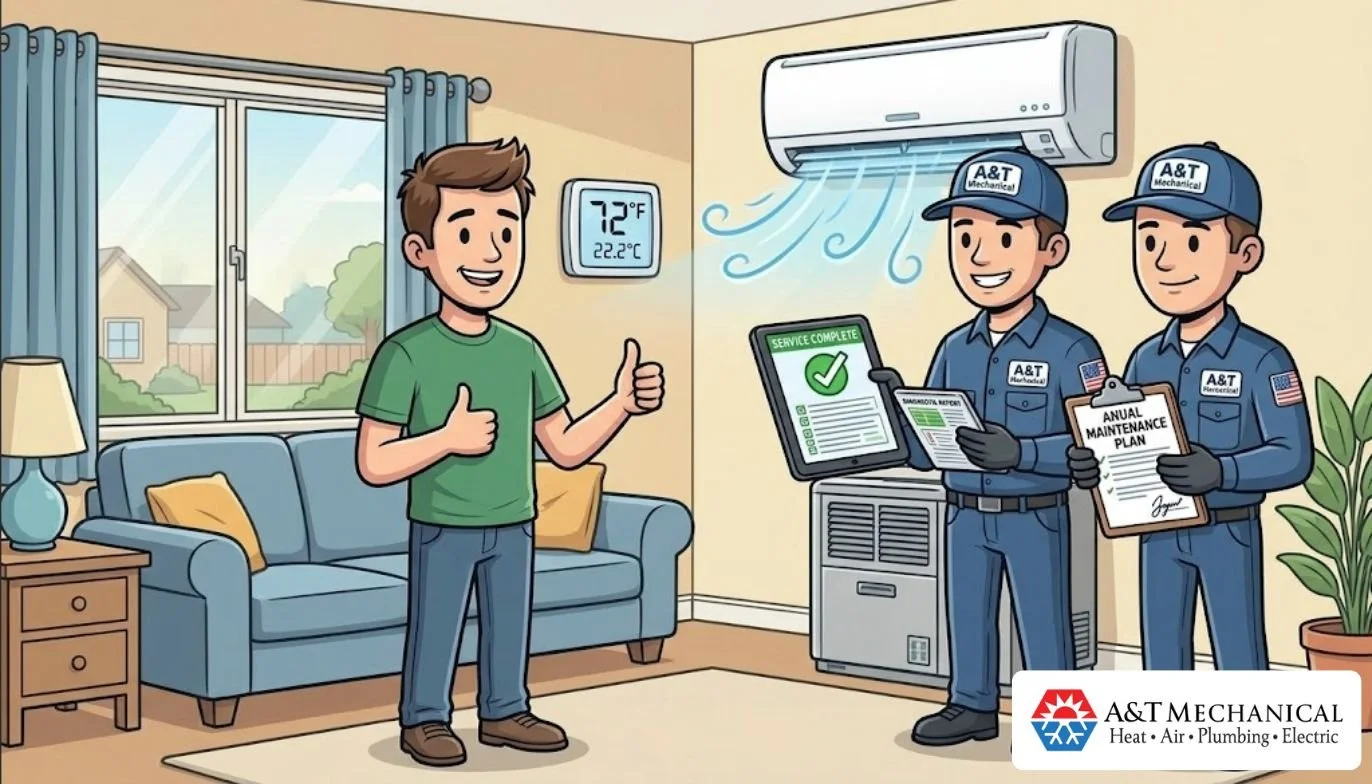
Their ongoing maintenance programs also serve the documentation function that makes warranty claims stronger: a home with an annual maintenance record from a licensed HVAC contractor Edmond OK is in a significantly better position to defend against "improper maintenance" denial grounds than one without any professional service history. That's not a coincidence. It's the natural outcome of a genuine, long-term service relationship.
A&T Mechanical Heat & Air Services, Inc. Proudly Serving Spring Creek and Surrounding Areas in Edmond, Oklahoma
A&T Mechanical Heat&Air Services, Inc. is committed to supporting the residents of Spring Creek. Our location is conveniently situated near Chisholm Elementary School, close to the intersection of Lytal Lane and Spring Hill Drive (coordinates: 35.62180460132168, -97.45144291255265), making it easy for locals to access our HVAC Contractor Edmond OK.
Trusted HVAC Contractor Services in Spring Creek You Can Rely On
Call or contact us to learn more.
Directions from Spring Creek to A&T Mechanical Heat & Air Services, Inc.
Conclusion
The question of whether to call your HVAC contractor Edmond OK or your home warranty company first doesn't have a universal answer, but it does have a clear decision framework. In health and safety emergencies, particularly during Edmond OK's intense summer heat or sharp winter cold snaps, speed wins and the contractor comes first. For major component failures that clearly fall within warranty coverage, the financial offset justifies the process. For minor repairs, exclusion-category failures, and situations where you have a trusted contractor with direct availability, the warranty path often adds cost and delay without meaningful benefit.
The homeowners who navigate this decision best are the ones who understand their warranty coverage before they need it, have an established relationship with a trusted HVAC contractor Edmond OK before the emergency occurs, and approach each situation with accurate information rather than habit or assumption.
A&T Mechanical Heat&Air Services, Inc. is the team that Edmond OK homeowners can build that trusted relationship with. Reach out today, establish that connection, and enter your next HVAC decision with the information and the support you need to make the right call.
FAQs
1. If I call a private HVAC contractor first and then try to use my home warranty, will the warranty still pay?
This depends entirely on your specific warranty contract's terms. Some home warranties allow you to hire a contractor of your choice in emergency situations, particularly if you cannot reach their service line or if they cannot dispatch a technician within a defined time window. These policies typically require prior authorization before the repair is performed and then reimburse based on the warranty's coverage rates, which may be lower than what you paid your contractor. Read your specific contract's emergency provisions carefully and always attempt to notify the warranty company before or during the repair, not after, to preserve your reimbursement options.
2. What counts as an HVAC "emergency" that allows me to bypass the home warranty process?
Most home warranty companies define emergency situations as conditions that create an immediate health or safety risk. This typically includes complete heating failure when outdoor temperatures are at or near freezing, complete cooling failure during an extreme heat event, and any failure that creates a fire, carbon monoxide, or gas leak risk. Document the temperature conditions, the health status of household members, and your attempts to reach the warranty company when using the emergency exception. The more thoroughly you document the emergency conditions, the stronger your position if a reimbursement claim is disputed.
3. How can I find out exactly what my home warranty covers before my HVAC system fails?
Read the coverage document and pay specific attention to the exclusions section rather than the marketing summary. Call your warranty company's customer service line and ask them directly: what HVAC component failures are excluded from coverage? What maintenance requirements must be met for coverage to apply? Is there a coverage cap on any specific component? Are refrigerant leaks covered, and if so, up to what amount? Getting these answers in advance, and noting the representative's name and the date of the conversation, gives you accurate expectations and documentation that supports any future claim.
4. Does having regular professional HVAC maintenance genuinely help with warranty claims?
Yes, significantly. Many warranty claim denials are based on "lack of proper maintenance" provisions in the contract. A home with documented annual professional maintenance visits from a licensed HVAC contractor Edmond OK provides records that directly contradict this denial basis. In practical terms, a homeowner who can produce two years of professional maintenance records is in a much stronger position to challenge a maintenance-based denial than one with no records at all. This is one of the most concrete financial benefits of a regular professional maintenance relationship.
5. Is it worth keeping a home warranty if I already have a trusted HVAC contractor relationship?
For most homeowners, a home warranty provides its clearest value when major component failures occur on systems that would otherwise represent significant out-of-pocket expense. If you have an aging HVAC system, the potential for a compressor or heat exchanger failure that costs $2,000 to $4,000 may justify the annual warranty premium, even accounting for its limitations. For newer systems with manufacturer warranties still in effect, the value proposition is weaker. The honest calculation involves your system's age and condition, the specific coverage your warranty provides, and your financial preference for predictable annual premiums versus variable out-of-pocket repair costs.
Written by A&T Mechanical Heat&Air Services, Inc. | Updated June 2026