
Emergency Electrician in Edmond OK: What to Do When Your Breaker Won't Stop Tripping
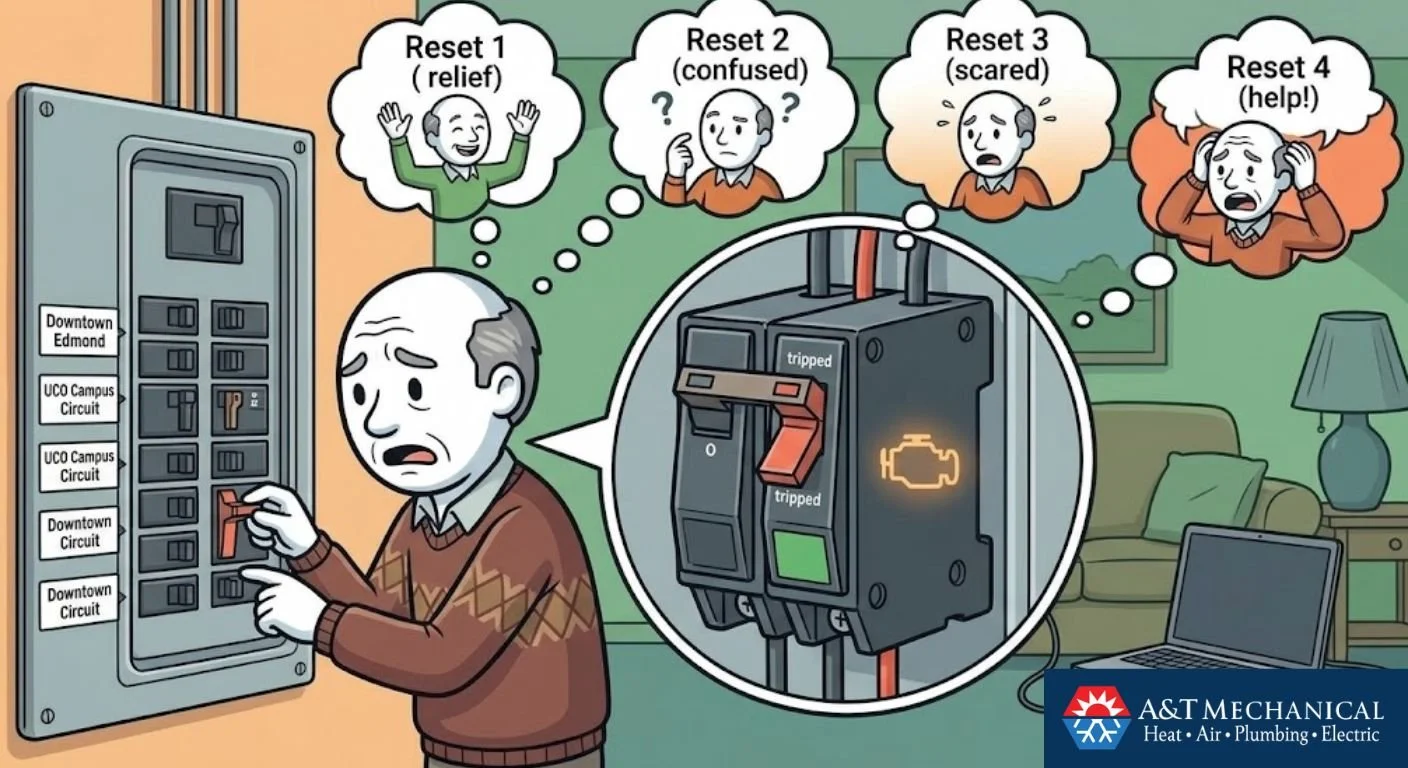
You reset the breaker. Power comes back on. You breathe a sigh of relief. Ten minutes later, it trips again. So you reset it a second time. Then a third. And somewhere around the fourth reset, a quiet but very reasonable fear starts to creep in: something is wrong, and flipping that switch back and forth isn't fixing it.
A breaker that keeps tripping is one of the most common electrical issues homeowners face, but it's also one of the most misunderstood. Most people treat it like a nuisance rather than a warning. The truth is, a repeatedly tripping breaker is your electrical system doing exactly what it was designed to do: telling you that something is wrong, and doing everything it can to prevent a much worse outcome.
In this guide, we're going to walk through exactly what's happening when your breaker won't stop tripping, what you should and shouldn't do in the moment, when it crosses into genuine emergency territory, and how a trusted electrician Edmond OK team like A&T Mechanical Heat&Air Services, Inc. can diagnose and resolve the problem safely and permanently.
When a Tripping Breaker Becomes a Real Emergency
Not every breaker trip is a crisis. Sometimes the explanation is simple: you plugged in a space heater while running the microwave on the same circuit, and the load was just too much. Reset it, spread the load out, done. But that's the best-case scenario, and it doesn't describe every situation.
The Difference Between a One-Time Trip and a Recurring Problem
A single breaker trip that doesn't repeat is usually nothing to worry about. It's the equivalent of your car's check engine light coming on briefly and then going off, probably just a momentary fluctuation. But a breaker that trips repeatedly, trips immediately after being reset, or trips without any obvious explanation is telling a very different story. It's not a blip. It's a pattern. And patterns in electrical behavior almost always point to an underlying issue that requires professional diagnosis.
Why Homeowners Should Never Ignore a Frequently Tripping Breaker
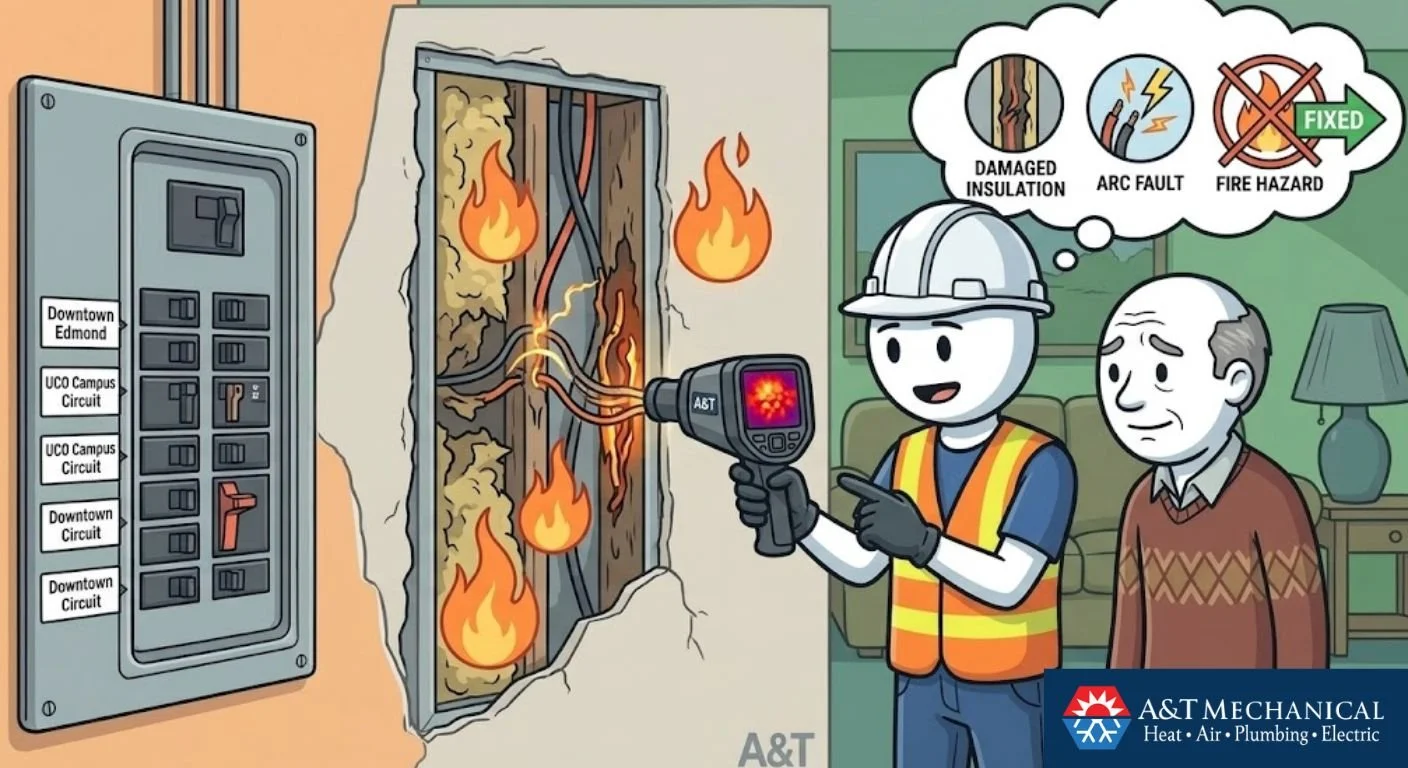
Here's the thing about electrical problems: they don't get better on their own. Unlike a squeaky door hinge that you can live with indefinitely, an electrical fault left unaddressed tends to escalate. A circuit that's chronically overloaded stresses the wiring over time. A short circuit that isn't found and fixed can cause arcing inside a wall cavity. A ground fault near a water source creates ongoing shock hazard. Every time a homeowner resets a tripping breaker without understanding why it's tripping, they're essentially asking their electrical system to keep absorbing a problem that it's desperately trying to shut down.
In Edmond OK, where homes range from brand-new builds to structures with decades-old wiring, the stakes of electrical negligence are real. Getting a qualified electrician Edmond OK professional involved sooner rather than later is always the right move.
How Your Circuit Breaker Actually Works
Before you can understand why a breaker keeps tripping, it helps to understand what the breaker is actually doing and why it was designed the way it was.
The Breaker's Job: Your Home's First Line of Defense
Think of your circuit breaker panel as the air traffic control tower for your home's electrical system. Every circuit in your house, every group of outlets, lights, and hardwired appliances, runs back to a dedicated breaker in that panel. The breaker's job is to monitor the amount of current flowing through its circuit and automatically shut it down if that current exceeds a safe threshold.
This is not a defect or a weakness in the system. It's the safety mechanism working exactly as intended. The breaker trips to prevent the wiring from overheating, which is the primary cause of electrical fires in residential structures. Without breakers doing their job, excessive current would just keep flowing through the wiring until something ignited.
What Happens Inside the Breaker When It Trips
Inside each breaker is a bimetallic strip and an electromagnetic component. Under normal operation, current flows through the breaker without issue. When current exceeds the rated ampacity of the breaker, the bimetallic strip heats up, bends, and mechanically disconnects the circuit. For sudden, high-magnitude faults like short circuits, the electromagnetic component reacts almost instantaneously to disconnect the circuit before any significant heat can build up.
When a breaker trips, it physically moves to a middle position between "on" and "off." To reset it, you push it fully to "off" first, then back to "on." If it trips again immediately or within a short time, the fault condition that triggered it in the first place hasn't been resolved. More resets won't change that.
The Most Common Reasons Your Breaker Keeps Tripping
A recurring breaker trip can stem from several different causes. Knowing which category your situation falls into helps determine the urgency and the appropriate response.
Circuit Overload: Too Many Demands on One Line
The most common cause of a tripped breaker is a circuit overload. This happens when the combined electrical demand of all the devices on a circuit exceeds what that circuit is rated to handle. A 15-amp circuit, for example, is designed to safely carry up to about 1,800 watts of continuous load. If you're running a space heater, a laptop charger, a lamp, and a TV on the same circuit simultaneously, you may well be pushing past that threshold.
Circuit overloads are common in older homes where the original electrical layout simply wasn't designed for the volume and variety of devices we use today. What was once a living room with a lamp and a television is now a room full of smart devices, gaming systems, sound equipment, and charging stations, all competing for power through wiring that hasn't changed since the house was built.
Short Circuits: The Sudden and Dangerous Fault
A short circuit is a more serious condition. It occurs when a hot wire, meaning a wire carrying current, makes unintended contact with a neutral wire or a ground wire. This contact creates a sudden, massive surge of current that the breaker responds to immediately by tripping.
Short circuits can happen inside an appliance or extension cord, at an outlet or switch, or within the wiring inside your walls. They're often the result of damaged insulation, loose connections, or faulty devices. A short circuit that's inside an appliance is usually resolved by removing that appliance from the circuit. A short circuit within the wiring or at a fixture is a more serious matter that requires hands-on investigation by a licensed electrician Edmond OK professional.
Ground Faults: The Hidden Electrical Hazard
A ground fault is similar to a short circuit but specifically involves current taking an unintended path to the ground. Ground faults are particularly common in areas where moisture is present, including bathrooms, kitchens, garages, and outdoor circuits. They're dangerous because a human body can become part of that unintended ground path, resulting in electric shock.
Many modern circuits in these areas are protected by GFCI (ground-fault circuit interrupter) devices, which detect ground faults and trip faster than standard breakers. If your GFCI outlet keeps tripping rather than a panel breaker, a ground fault near moisture is a likely culprit.
How to Tell the Difference Between an Overload and a Short Circuit
The behavior of the breaker gives you clues. An overload typically causes the breaker to trip after a period of use, once the thermal element has had time to respond to sustained excess current. A short circuit causes the breaker to trip suddenly and immediately, often with a popping sound or a flash. If your breaker trips the instant you turn on a specific device or flip a particular switch, a short circuit is the likely cause. If it trips after running normally for a while, overload is more probable.
What to Do Immediately When Your Breaker Won't Stop Tripping
Your first instinct might be to keep resetting and hope for the best. Resist that instinct. Here's a smarter, safer approach.
Step One: Stop Resetting It Blindly
Every time you reset a breaker without addressing the underlying cause, you're asking a safety device to ignore the signal it's sending. Repeatedly resetting a breaker that keeps tripping under a fault condition creates heat and mechanical wear on the breaker itself, and it keeps your home exposed to whatever hazard the breaker is trying to shut down. Reset it once to see if it holds. If it trips again quickly, stop resetting it and move to the next step.
Step Two: Unplug Devices and Reduce the Load
If you suspect an overload, start by unplugging everything on the affected circuit. Go room by room and identify which outlets are on that circuit. Unplug every device from those outlets. Then reset the breaker. If it holds, plug devices back in one at a time, waiting a minute between each, until you identify what's pushing the circuit over its limit. Distribute high-draw devices across multiple circuits rather than running them all from one line.
If the breaker trips even with nothing plugged in, the problem isn't overload. It's likely a short circuit or fault in the wiring itself, and that means you need a professional.
Step Three: Check for Warning Signs Before Calling for Help
Before you call an electrician Edmond OK service, do a quick visual check of the affected outlets, switches, and the panel itself. Look for any discoloration, burn marks, or melted plastic around outlets or switches. Smell for any burning odor near the panel or affected outlets. Check whether the breaker itself feels unusually hot to the touch. None of these are things to try to fix yourself. They're information to share with the technician when you call, because they help pinpoint the problem before the electrician even arrives.
Situations That Require an Emergency Electrician Edmond OK Right Away
Some situations move beyond the "schedule a service call" category into genuine emergency territory. Knowing when to escalate is critical.
Burning Smell, Sparks, or Scorch Marks
A burning smell coming from your panel, an outlet, or anywhere along a wall is a serious red flag. It often means that wiring insulation is overheating or that arcing is occurring inside a wall cavity. Visible sparks when plugging in devices, or black scorch marks around outlets and switch plates, indicate that an electrical fault has already caused localized burning. These scenarios require immediate professional attention. Do not continue using the affected circuit under any circumstances.
A Breaker That Trips Immediately After Reset
If your breaker returns to the tripped position the moment you reset it, the fault condition that's triggering it is still fully active. This could indicate a dead short somewhere on the circuit, a ground fault, or a failing breaker that can no longer hold its position. An immediately tripping breaker is one of the clearest signals that something is seriously wrong and that a licensed electrician Edmond OK technician needs to evaluate the circuit as soon as possible.
Multiple Circuits Failing at the Same Time
When multiple breakers trip simultaneously, or when you lose power to large sections of your home at once, the problem may be at the panel level rather than on any individual circuit. This could point to a failing main breaker, an issue with your utility service connection, or internal panel damage. These are high-stakes situations where the entire home's electrical supply may be compromised.
When to Turn Off Your Main Breaker and Wait for Professional Help
If you smell burning coming from the panel, see visible scorching or melting inside the panel box, or notice any sparking near the main breaker, turn off your main breaker immediately if it is safe to do so. This cuts power to the entire home and eliminates the immediate risk of fire or electrical fault escalation. Once the main is off, evacuate if necessary and call for emergency electrical service. Do not re-energize the panel until a licensed technician has inspected and cleared it.
What an Electrician Edmond OK Professional Will Do Upon Arrival
Understanding what happens when a professional shows up helps set expectations and demonstrates why their involvement is so much more effective than repeated DIY resets.
Diagnostic Process: Finding the Root Cause
A qualified electrician Edmond OK technician doesn't just reset the breaker and call it done. They begin with a systematic diagnostic process designed to identify exactly what is causing the fault. This typically includes inspecting the panel for signs of damage or overheating, using specialized testing equipment to check circuit continuity and resistance, identifying any short circuits or ground faults within the wiring, and evaluating the load profile of the affected circuit to determine whether it's adequately sized for its current demand.
The diagnostic phase is arguably the most important part of the job. A correctly identified root cause leads to a correctly targeted repair. Guessing, skipping steps, or treating only the surface symptom is how problems come back.
Repair, Replacement, or Full Panel Upgrade
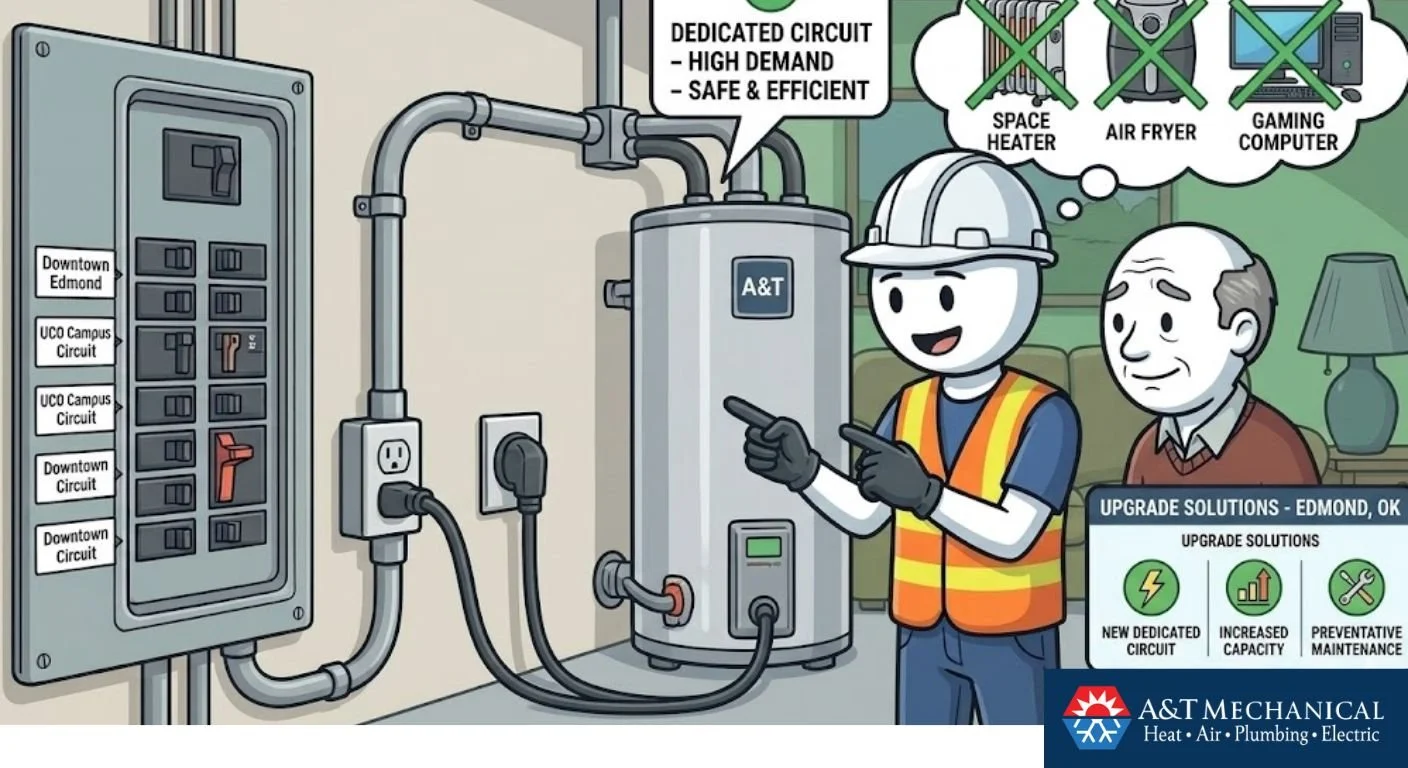
Once the cause is identified, the technician will outline the appropriate solution. For a simple overload, the fix might be redistributing loads or adding a new dedicated circuit. For a short circuit in an appliance, removing or replacing that device resolves the issue. For wiring faults, damaged sections may need to be replaced. For a failing breaker, swapping the breaker itself is often a quick and straightforward fix.
In cases where the panel itself is undersized, outdated, or showing signs of deterioration, a full panel upgrade may be the recommended path. A thorough professional will walk you through each option clearly, honestly, and without pressure, giving you the information you need to make the best decision for your home.
How A&T Mechanical Heat&Air Services, Inc. Handles Electrical Emergencies
When electrical emergencies arise in Edmond OK, homeowners need a team that responds with speed, expertise, and the kind of honest communication that builds lasting trust. That's exactly what A&T Mechanical Heat&Air Services, Inc. delivers.
The team at A&T Mechanical Heat&Air Services, Inc. understands that electrical emergencies don't follow a convenient schedule. They bring professional-grade diagnostic tools, deep technical knowledge, and a genuine commitment to resolving problems completely rather than just temporarily. Whether the call is for a repeatedly tripping breaker, a suspected short circuit, a failing panel, or any other urgent electrical issue, they approach every job with the thoroughness that homeowners deserve.
What truly sets A&T Mechanical Heat&Air Services, Inc. apart is their dedication to transparency. They explain what they find in plain language, outline their recommended solutions clearly, and never push unnecessary services. In an industry where homeowners can feel vulnerable and overwhelmed during an emergency, that combination of skill and integrity makes all the difference. When you need a dependable electrician Edmond OK team that treats your home like their own, A&T Mechanical Heat&Air Services, Inc. is the call to make.
Preventive Steps to Avoid Future Breaker Emergencies
Once your immediate problem is resolved, taking a few proactive steps can significantly reduce the likelihood of facing the same situation again.
First, have a licensed electrician perform a comprehensive panel inspection if your home is more than 15 to 20 years old and has never had one. Aging components, outdated breaker brands, and deteriorating wiring are all things that a professional eye can identify before they cause an emergency.
Second, be mindful of how you distribute electrical loads throughout your home. High-draw appliances like space heaters, air fryers, electric kettles, and hair dryers should ideally be used on circuits that aren't already carrying significant loads. Avoid daisy-chaining extension cords and power strips, as this is one of the easiest ways to unknowingly overload a circuit.
Third, consider adding dedicated circuits for high-demand areas or appliances. If your kitchen, home office, or workshop consistently pushes circuits to their limits, a new dedicated circuit is a relatively affordable investment that provides lasting relief and eliminates recurring overload trips.
Finally, replace any outlets or switches that show discoloration, feel warm, or produce sparking when devices are connected. These are signs of worn or faulty connections that create ongoing risk.
A&T Mechanical Heat & Air Services, Inc. Proudly Serving Vintage Gardens and Surrounding Areas in Edmond, Oklahoma
A&T Mechanical Heat&Air Services, Inc. is committed to supporting the residents of Vintage Gardens. Our location is conveniently situated near The Vintages At Camden Park, close to the intersection of NW 158th Street and Lacebark Lane (coordinates: 35.6355341299027, -97.53831958224507), making it easy for locals to access our Electrician Edmond OK.
Trusted Electrician Services in Vintage Gardens You Can Rely On
Call or contact us to learn more.
Directions from Vintage Gardens to A&T Mechanical Heat & Air Services, Inc.
Conclusion
A breaker that keeps tripping isn't a minor inconvenience to dismiss or push past with repeated resets. It's a safety signal from your electrical system, telling you clearly and urgently that something isn't right. Whether the cause is a simple overload, a dangerous short circuit, a ground fault, or a failing panel, the right response is the same: stop resetting blindly, assess the situation carefully, and get a qualified professional involved before the problem escalates into something far more serious.
In Edmond OK, homeowners have a trusted, skilled team ready to respond. A&T Mechanical Heat&Air Services, Inc. brings the expertise, the professionalism, and the genuine care that electrical emergencies demand. Don't wait for a tripping breaker to become a fire hazard or a safety crisis. Call the electrician Edmond OK team you can count on, and get the problem diagnosed and resolved correctly the first time.
FAQs
1. Is it safe to keep resetting a breaker that keeps tripping?
No, it is not safe to repeatedly reset a breaker that keeps tripping without understanding why it's tripping. Each reset re-exposes your home to the fault condition the breaker is responding to. If the breaker trips once due to a simple overload that you've already resolved by unplugging devices, a single reset is fine. But if the breaker trips repeatedly or immediately after being reset, stop resetting it and contact a licensed electrician Edmond OK professional for a proper diagnosis.
2. Can a bad appliance cause a breaker to keep tripping?
Absolutely. A faulty appliance with damaged internal wiring, a worn motor, or defective components can create a short circuit or ground fault that trips the breaker every time it's connected and powered. If your breaker only trips when a specific device is in use, that device is the likely culprit. Unplug it, test the circuit with other devices to confirm the breaker holds, and have the appliance inspected or replaced before using it again.
3. How do I know if my breaker itself is faulty and needs to be replaced?
A breaker that trips under loads well below its rated ampacity, feels loose or wobbly in the panel, trips immediately upon reset with no load connected, or shows visible signs of burning or discoloration is likely faulty and needs replacement. Breakers have a finite lifespan and do fail over time, particularly in homes with panels that are decades old. Breaker replacement is a job for a licensed electrician, as it requires working directly inside the panel.
4. What's the danger of a breaker that trips and doesn't reset at all?
A breaker that won't reset, meaning it won't hold in the "on" position or immediately springs back to "off," indicates either a persistent active fault on the circuit or a mechanically failed breaker. In either case, power to that circuit should remain off until a professional evaluates it. Forcing a breaker to stay on when it's refusing to hold is dangerous and can allow a fault condition to persist, potentially causing wiring damage or fire.
5. How long does it typically take an electrician to diagnose and fix a tripping breaker issue?
Diagnosis time varies depending on the complexity of the problem. A straightforward overload or a clearly faulty appliance can be diagnosed in under an hour. A wiring fault, short circuit within the walls, or panel-level issue may require more thorough investigation and take several hours. Your electrician Edmond OK technician will give you a realistic timeframe once they've completed their initial assessment and identified the nature of the problem.
Written by A&T Mechanical Heat&Air Services, Inc. | Updated May 2026