
Slow Kitchen Sink Drain in Edmond OK? Here's When to Call a Professional
You notice it first while rinsing dishes. The water pools a little longer than it used to. Then a little longer than that. Within a few weeks, doing the dishes means watching three inches of murky water sit in the basin before it lazily creeps down the drain. It's annoying. It's inconvenient. And for most homeowners, the instinct is to reach for a bottle of drain cleaner, dump it in, and hope for the best.
Here's the thing: that approach may give you a few days of relief, but it almost never solves the actual problem. And the problem is almost certainly getting worse underneath the surface, even when the drain seems to clear temporarily.
In this guide, we're going to lay out exactly what causes a slow kitchen sink drain, what the DIY approaches can and can't do, and most importantly, how to recognize when the situation calls for professional drain cleaning Edmond OK service. By the end, you'll know precisely how to handle this problem rather than just managing it.
Why a Slow Kitchen Drain Deserves More Attention Than You're Giving It
Most homeowners treat a slow kitchen drain the way they treat a mildly annoying coworker: they tolerate it, work around it, and put off dealing with it indefinitely. That strategy works for a while. Then it doesn't.
The Slow Drain That Becomes a Stopped Drain
A slow drain isn't a stable condition. It's a deteriorating one. The same buildup that's causing the current partial restriction is still accumulating every time you run the sink. Grease clings to grease. Soap residue builds on soap residue. The restriction that makes your drain slow today becomes the blockage that brings it to a full stop next month, often at the worst possible time: when you're in the middle of cooking a holiday meal or cleaning up after hosting guests.
The progression from slow to stopped rarely announces itself with much warning. One day, the drain is just manageable enough not to feel urgent, and the next day, you have standing water that won't move at all. Understanding this timeline helps reframe a slow drain from a minor nuisance into a situation worth addressing sooner rather than later.
Why Kitchen Drains Are Uniquely Vulnerable
Not all drains are created equal, and kitchen drains face a category of challenges that bathroom drains and utility sinks simply don't encounter. The kitchen is where grease, cooking oils, food particles, starchy residues, and soap all converge in a daily torrent. Every pan rinsed, every greasy plate cleaned, every pot of pasta drained sends a complex mixture of clog-building material down the drain.
Your kitchen drain also tends to be connected to your dishwasher line, which contributes its own regular load of food debris and detergent residue. And unlike a bathroom sink, where you have some control over what goes down the drain, the kitchen sink handles whatever comes off your dishes, which includes everything you cooked with that day.
What's Actually Causing Your Kitchen Sink to Drain Slowly
Diagnosing the cause correctly is the foundation of fixing it effectively. Kitchen drain slowdowns typically come from one of a few specific sources, and knowing which one you're dealing with shapes the right response.
Grease and Fat Buildup: The Number One Kitchen Drain Offender
Grease is the most common culprit in kitchen drain problems, and it's one of the most persistently misunderstood ones. The misconception is that running hot water while rinsing greasy dishes or pans washes the grease safely down the drain. It doesn't.
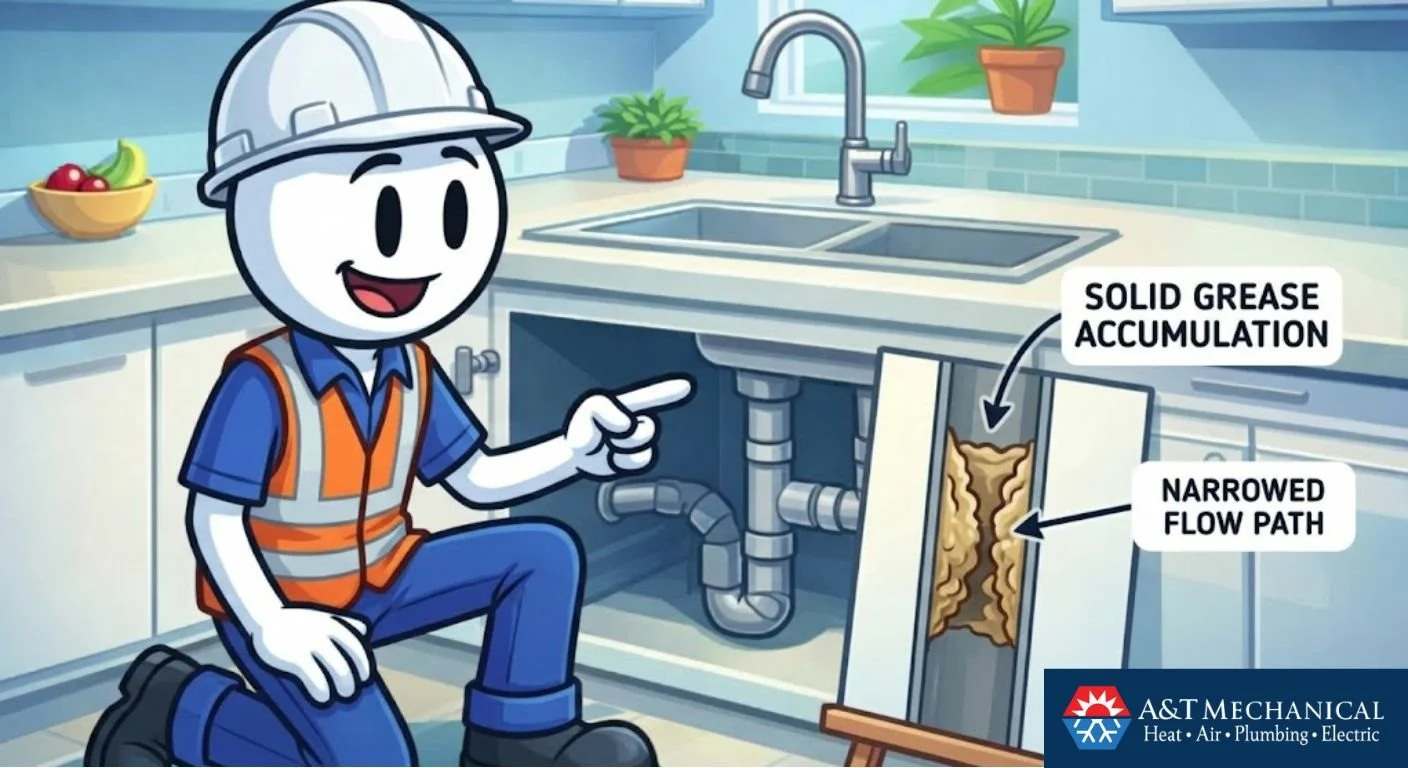
Hot water keeps grease in a liquid state long enough to travel a few feet down the drain line. But as soon as that grease-laden water cools, the grease solidifies and adheres to the pipe walls with remarkable tenacity. It doesn't all wash away in one pass. It leaves a thin coating that stays behind. And every time you rinse more grease down the drain, another layer adds to the one before it.
Over weeks and months, this process creates a progressively narrowing interior diameter inside the pipe. Picture the inside of the pipe as a highway, and each layer of solidified grease as a lane closure. At first, traffic still flows. But close enough lanes, and eventually, nothing gets through. The pipe doesn't need to be completely blocked to cause serious drainage problems. A pipe that's 60% narrowed by grease accumulation drains noticeably slowly, and the rough interior surface of the grease layer catches other debris far more aggressively than a clean pipe would.
Food Particles and the P-Trap Problem
Even with a garbage disposal or a sink strainer, food particles make it into your drain system. Small bits of food, starchy residue from pasta or rice cooking water, and organic material from washing vegetables all travel down the drain and encounter the P-trap, the curved pipe section directly below your sink, designed to hold water and prevent sewer gases from entering your home.
The P-trap is essential, but its curved geometry also makes it a natural collection point for debris. Heavy particles settle in the bottom of the curve rather than flowing onward. Over time, this sediment accumulates and partially obstructs the trap, reducing flow significantly. A partially obstructed P-trap combined with grease buildup further down the line creates a compounding problem that gets worse with every load of dishes.
Soap Scum and Detergent Residue
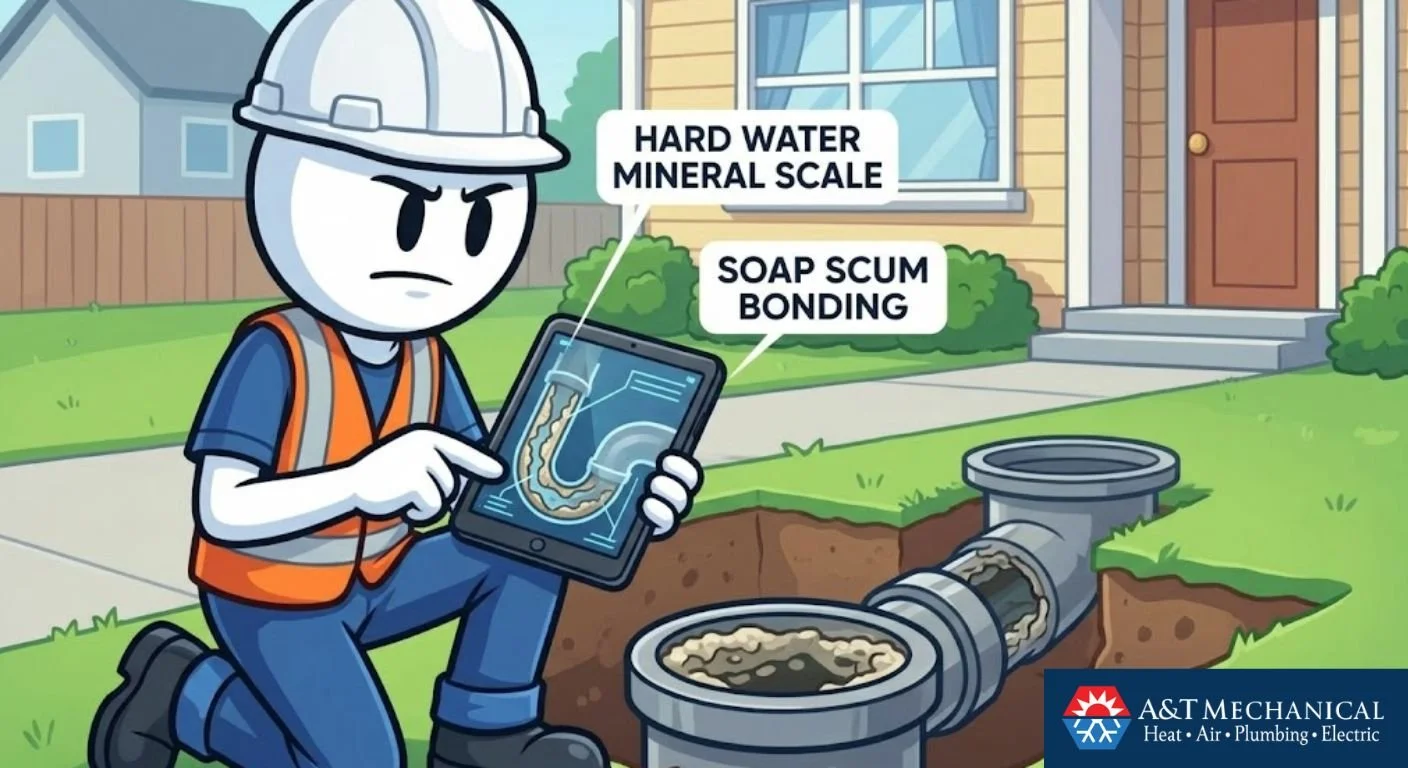
Dish soap and dishwasher detergent contribute to drain buildup in ways that aren't always obvious. Soap doesn't simply rinse away cleanly. It leaves a residue film inside pipes that bonds with grease, mineral deposits, and food particles. Over time, this soap scum builds into a sticky, cohesive mass that narrows the pipe interior and provides an exceptionally effective surface for catching additional debris.
In hard water areas, soap scum combines with dissolved minerals to form a particularly dense and stubborn deposit called soap curd. This combination is significantly harder to clear than standard soap residue alone and often requires professional-grade hydrojetting rather than basic drain snaking to fully remove.
When the Problem Is Deeper Than the Kitchen Drain Itself
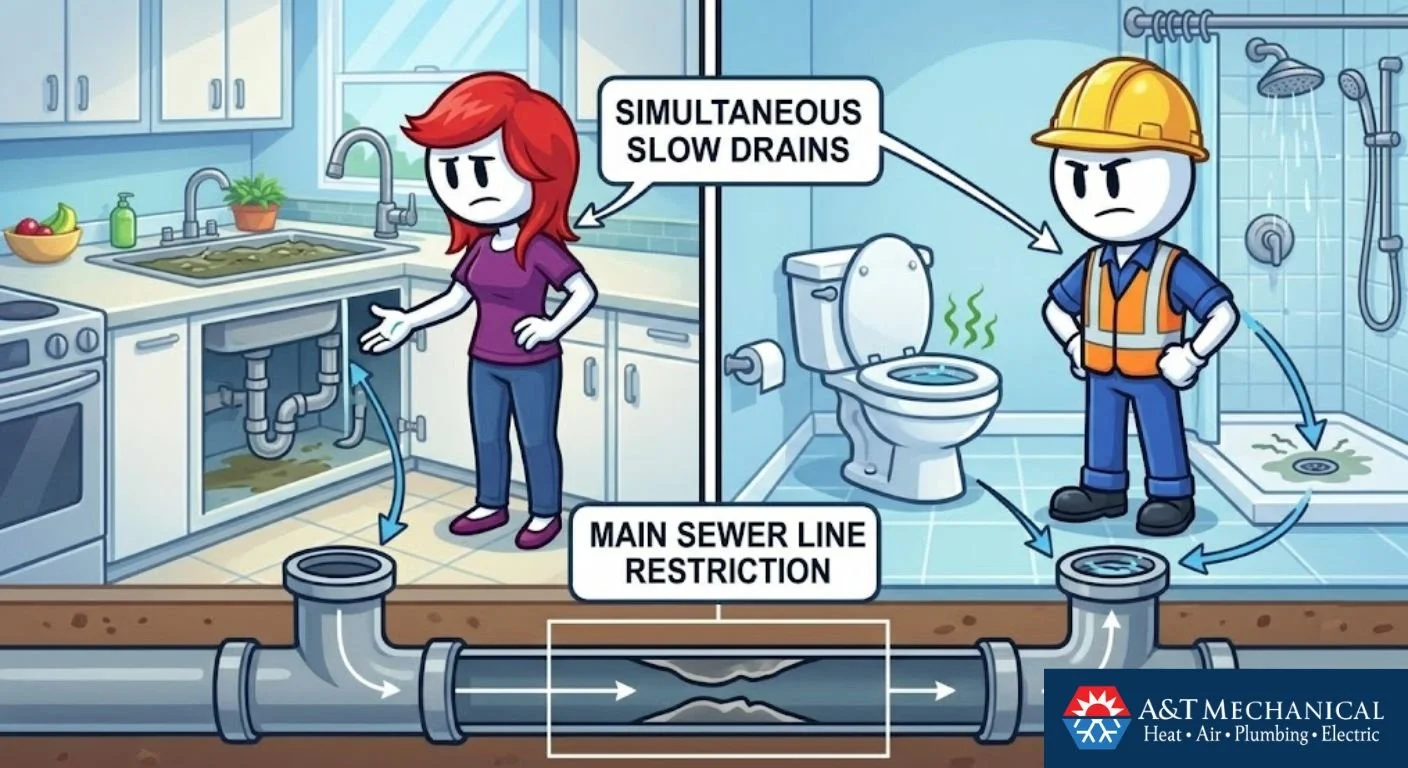
Sometimes what looks like a kitchen drain issue is actually a symptom of a problem further down the line, in the main drain branch that serves multiple fixtures, or in the main sewer lateral itself. If the slow drainage persists even after you've addressed the kitchen drain specifically, or if the problem coincides with slowdowns in other drains throughout the home, the restriction may be located in a section of pipe that's well beyond the kitchen plumbing. This is an important distinction because it changes both the diagnostic approach and the solution required.
DIY Approaches: What Actually Works and What Doesn't
Before calling a professional, most homeowners try a few home remedies first. Some of these are genuinely worth attempting. Others are largely ineffective or actively harmful.
The Boiling Water Method and Its Limits
Pouring boiling water directly into a grease-affected kitchen drain is a legitimate first step that occasionally provides genuine relief for minor, recent grease buildups. Boiling water temporarily reliquefies solidified grease near the drain opening and can flush it further through the system. If you're dealing with a fresh, minor grease issue, boiling water may be enough to restore normal flow.
However, this method has real limitations. It only addresses grease that's close to the drain opening and in liquid-compatible form. It does nothing for compacted grease buildup deep in the line, food particle accumulation in the P-trap, soap scum deposits, or any mineral-related buildup. And on older pipes with PVC connections, repeatedly pouring boiling water can soften joints over time. Use this method as a first attempt on a mildly slow drain, not as a repeated solution to a persistent problem.
Baking Soda and Vinegar: Useful or Overhyped?
The baking soda and vinegar drain treatment is one of the most commonly recommended DIY remedies online, and it's worth understanding what it actually does. The fizzing reaction between baking soda (a base) and vinegar (an acid) creates carbonic acid and carbon dioxide gas. The bubbling action can help dislodge minor, loose debris near the drain entrance.
What it won't do is dissolve compacted grease, break through solid soap scum deposits, or reach blockages further down the pipe. The reaction is relatively brief and gentle compared to the mechanical force needed to address established buildup. This treatment is more useful for freshening drain odors than for resolving a genuine slow drain caused by accumulated material.
Plunging a Kitchen Sink the Right Way
A proper plunge can sometimes clear a slow kitchen drain, particularly if the restriction is in the P-trap area. For kitchen sinks with two basins, seal the overflow drain in the second basin with a wet rag before plunging to concentrate the pressure on the clog. Use a flat-bottomed cup plunger rather than a flange plunger, which is designed for toilets. Ensure you have a good seal over the drain opening and use firm, consistent strokes rather than overly aggressive ones that could stress pipe joints.
Plunging works best on blockages that are loose and relatively close to the drain. If the restriction is from compacted grease buildup on pipe walls along a longer section of pipe, plunging won't do much to change the fundamental situation.
Why Chemical Drain Cleaners Are Doing More Harm Than Good
This deserves a direct, unambiguous statement: liquid chemical drain cleaners are one of the worst things you can put in your kitchen drain. They're not just ineffective for most kitchen drain problems. They're actively damaging.
Most chemical drain cleaners work through highly caustic chemical reactions that generate significant heat inside the pipe. On older metal pipes, this heat and chemical exposure accelerates corrosion and internal degradation. On PVC pipes, repeated exposure to caustic chemicals can soften, weaken, and discolor the material over time. Drain cleaners also pose serious health risks through skin contact, inhalation, and potential splashback.
More importantly, chemical cleaners rarely reach the actual source of a kitchen drain problem. Grease buildup coating the pipe walls along a 10-foot section doesn't dissolve from a single application of caustic liquid. At best, a chemical cleaner opens a temporary narrow channel through a soft clog near the drain entrance and provides a false sense that the problem is resolved. The buildup remains, and the drain slows again within days to weeks.
Clear Signs It's Time to Call a Drain Cleaning Edmond OK Professional
Knowing when to escalate from DIY attempts to professional service is one of the most valuable pieces of knowledge a homeowner can have. Here are the specific scenarios that call for professional drain cleaning Edmond OK intervention.
The Drain Has Slowed Again After a Recent Cleaning
If you've already cleared the kitchen drain recently, whether yourself or through a previous service call, and it's slow again within a few weeks or months, you have a persistent underlying condition that surface-level clearing isn't addressing. This pattern is a clear signal that the cause of the problem hasn't been identified and treated. A professional camera inspection is the appropriate next step to determine what's actually creating the repeated buildup.
Multiple Drains Are Slow or Backing Up Simultaneously
A single slow kitchen drain usually indicates a localized problem in or near the kitchen plumbing. But when the kitchen drain slows at the same time as the bathroom sink, or when the dishwasher drainage affects the kitchen sink, or when a toilet gurgles while you run the kitchen faucet, the problem is in a shared section of the drain system further downstream. This is no longer a kitchen drain problem. It's a main drain line issue that requires professional diagnosis and equipment to address effectively.
You Smell Sewage or Rotten Odors Near the Sink
A healthy drain system shouldn't produce sewer odors in your kitchen. A persistent sewage smell, a rotten egg odor, or the smell of decomposing organic material coming from the drain area indicates that something is wrong beyond normal buildup. A dry P-trap (caused by infrequent use), a cracked or broken P-trap, venting issues in the drain system, or a serious blockage that's causing waste to back up into accessible pipe sections can all produce these odors.
Sewage odors in the kitchen are a health concern and a symptom of a plumbing condition that warrants prompt professional attention. Don't mask the smell with air fresheners and hope it resolves. Call for service.
There's Standing Water That Won't Move at All
A completely stopped kitchen drain is an emergency-level inconvenience that needs professional resolution as quickly as possible. A sink that won't drain at all typically means a near-complete or complete blockage somewhere in the drain system. At this point, DIY approaches are unlikely to be sufficient, and continued attempts to force water down a fully blocked drain risk backing material up into the sink or causing overflow into the cabinet below.
Gurgling Sounds: What Your Pipes Are Trying to Tell You
Gurgling or bubbling sounds from your kitchen drain, particularly when the dishwasher runs or when you drain a full sink, are acoustic evidence of a drainage problem. The sounds occur when water tries to flow past a partial restriction, drawing in air from behind it, creating bubbles and the characteristic gurgling noise. Gurgling is often the earliest audible warning of a developing clog and should be treated as a prompt for investigation rather than a sound to tune out.
What Professional Drain Cleaning Edmond OK Service Actually Looks Like
When you call for professional drain cleaning Edmond OK service, the work that happens is fundamentally different from anything a consumer tool or product can accomplish.
Drain Camera Inspection: Seeing the Unseen
The most valuable diagnostic tool available to professional plumbers is the pipe camera, a waterproof camera mounted on a flexible cable that travels through your drain line and transmits live video. For a kitchen drain that's been slow repeatedly or that has developed new symptoms, camera inspection is the most accurate and efficient way to determine exactly what's happening inside the pipe.
The camera reveals the location and nature of the restriction: grease buildup, food debris, mineral scale, a displaced pipe joint, root intrusion (less common in kitchen lines than sewer laterals but possible), or a collapsed section. This diagnostic precision means the treatment can be targeted exactly where it's needed, and the effectiveness of the treatment can be verified by running the camera again after the cleaning is complete.
Hydrojetting vs. Drain Snaking: Choosing the Right Tool
Professional plumbers have two primary mechanical tools for clearing kitchen drain blockages, and choosing between them is based on the nature and severity of the problem.
Drain snaking uses a motorized cable with an attachment at the end to physically break apart or retrieve a clog. It's fast, effective for soft clogs near the drain opening or P-trap, and appropriate for blockages that are localized and relatively accessible. For a food particle accumulation in the P-trap or a moderate grease blockage near the drain entrance, snaking may be the right first tool.
Hydrojetting is a more comprehensive solution for established or widespread buildup. A specialized nozzle propels water at high pressure (typically 1,500 to 4,000 PSI) through the drain line, scouring the pipe walls clean and flushing all debris completely out of the system. For a kitchen drain with significant grease coating along a long pipe section, soap scum deposits, or mineral buildup, hydrojetting restores the pipe interior to near-original condition rather than just clearing a channel through the buildup.
How Edmond OK's Local Conditions Affect Kitchen Drain Health
Understanding the local context adds an important dimension to kitchen drain health in this area specifically.
Hard Water Mineral Buildup in Pipe Walls
Edmond OK's water supply has notable mineral content, which means hard water is a reality for most households here. Hard water leaves calcium and magnesium deposits on everything it contacts, including the interior walls of your drain pipes. These mineral deposits, called scale, create a rough interior surface that dramatically accelerates the accumulation of grease, soap residue, and food particles compared to what you'd see in a smooth, scale-free pipe.
Scale also combines with soap residue to create a particularly stubborn deposit that resists simple mechanical clearing. In homes that have never had professional drain cleaning, years of scale accumulation can reduce the effective interior diameter of kitchen drain pipes substantially. This is one of the reasons why homes in this area tend to have more persistent kitchen drain issues than the national average, and why periodic professional hydrojetting is more than just a convenience: it's a practical maintenance necessity.
Older Pipes and the Corrosion Factor
Many homes in Edmond OK have plumbing that dates back decades. Cast iron drain pipes, which were standard in homes built before the 1960s and 70s, develop significant interior corrosion over time. The rough, pitted interior surface of a corroded cast iron pipe catches debris with extraordinary efficiency, creating buildup conditions that are far worse than what you'd see in the same pipe if it were made of smooth PVC.
Older galvanized steel pipes have similar corrosion characteristics and the additional problem of internal rust, which creates fine particles that can actually contribute to drain line buildup. For homeowners in older Edmond OK properties, the pipe material itself is a factor in why kitchen drain problems recur more frequently and why professional cleaning is more often necessary.
How A&T Mechanical Heat&Air Services, Inc. Approaches Kitchen Drain Problems
When Edmond OK homeowners trust A&T Mechanical Heat&Air Services, Inc. for their kitchen drain issues, they get a team that approaches the problem with diagnostic rigor rather than a one-size-fits-all solution.
The process starts with understanding the history of the problem: how long it's been slow, what's been tried, whether other drains are affected, and what the home's plumbing age and material situation looks like. From there, camera inspection provides objective information about what's actually happening in the pipe, which guides the selection of the right cleaning method for the specific situation.
Whether the solution is targeted snaking, comprehensive hydrojetting, or a P-trap cleaning and inspection, A&T Mechanical Heat&Air Services, Inc. matches the treatment to the actual problem rather than applying the simplest available option. Their technicians explain what they find and what they're doing in plain language, and they don't recommend services the situation doesn't warrant.
For homeowners dealing with recurring drain cleaning Edmond OK needs, A&T Mechanical Heat&Air Services, Inc. also provides honest guidance on maintenance intervals and preventive practices that reduce future service needs. They treat every job as an opportunity to solve a problem permanently rather than to schedule the next call.
Preventing Future Kitchen Drain Problems
The most effective drain cleaning is the one you never need because you prevented the problem in the first place. A few consistent habits make a significant difference in kitchen drain health.
Never pour grease, cooking oil, or animal fat down the kitchen drain. Collect it in a container and dispose of it in the trash. This single habit eliminates the primary driver of kitchen drain buildup. Scrape plates into the trash or compost bin before rinsing them in the sink, keeping food particles out of the drain system. Run plenty of hot water while using the garbage disposal and for a full minute after you finish, to help flush debris through the system.
Using a quality sink strainer that catches food particles before they enter the drain adds another layer of protection. Cleaning the P-trap annually or whenever you notice the drain starting to slow is a simple maintenance task that prevents minor accumulation from becoming a serious blockage. And scheduling professional drain cleaning Edmond OK service every one to two years, depending on how heavily your kitchen sink is used, provides a comprehensive reset that keeps the pipe interior clean and clear regardless of what day-to-day use accumulates.
A&T Mechanical Heat & Air Services, Inc. Proudly Serving The Oaks and Surrounding Areas in Edmond, Oklahoma
A&T Mechanical Heat&Air Services, Inc. is committed to supporting the residents of The Oaks. Our location is conveniently situated near Memorial Park Cemetery, close to the intersection of Colin Trail and Green Cedar Terrace (coordinates: 35.60026162316142, -97.48418929590089), making it easy for locals to access our Drain Cleaning Edmond OK.
Trusted Drain Cleaning Services in The Oaks You Can Rely On
Call or contact us to learn more.
Directions from The Oaks to A&T Mechanical Heat & Air Services, Inc.
Conclusion
A slow kitchen sink drain is never just a minor inconvenience to tolerate indefinitely. It's an early warning from your plumbing system that buildup is accumulating, flow is being restricted, and the situation is heading toward something more serious if left unaddressed. The question isn't whether to deal with it. The question is how and when.
For minor, fresh slowdowns, the right DIY approaches can provide genuine short-term relief. But for recurring problems, persistent slowdowns that don't respond to basic home remedies, or any of the warning signs we've covered, professional drain cleaning Edmond OK service is the appropriate and cost-effective response. It solves the actual problem rather than the symptom, and it provides the diagnostic clarity that prevents the same issue from returning on a frustrating cycle.
A&T Mechanical Heat&Air Services, Inc. is the trusted partner for Edmond OK, homeowners who want kitchen drain problems resolved correctly, completely, and without unnecessary expense. Reach out today and get your kitchen sink back to the way it should be.
FAQs
1. Is it ever safe to use a garbage disposal to help clear a slow drain?
Running a garbage disposal while the drain is slow is generally not advisable. The disposal will grind whatever is in the sink, but if the drain line is already partially blocked, adding ground food material to a slow-moving system typically makes the situation worse. Clear the drain problem first, then resume normal garbage disposal use. Also make sure you're running plenty of cold water while using the disposal and for at least 30 to 60 seconds after, to flush ground material completely through the line.
2. How long does a professional kitchen drain cleaning typically take?
A straightforward kitchen drain cleaning, including a drain snake clearing or P-trap service, typically takes 30 to 60 minutes. If camera inspection is included to diagnose the cause of a recurring problem, add another 15 to 30 minutes. A hydrojetting service on a longer drain line section may take one to two hours depending on the pipe length and severity of the buildup. Your drain cleaning Edmond OK technician will give you a realistic time estimate based on what they find during the initial assessment.
3. Why does my kitchen drain smell bad even after I cleaned it?
Persistent drain odors after cleaning usually indicate one of a few things: a dry P-trap that's not maintaining its water seal and allowing sewer gas to enter through the drain, residual buildup further down the line that the cleaning didn't fully reach, a cracked P-trap or pipe joint allowing sewer gas to escape, or a venting issue in the drain system. If the odor persists after confirmed cleaning, a professional camera inspection can identify whether the issue is a vent blockage, a pipe defect, or a deeper line buildup.
4. My dishwasher seems to drain into the kitchen sink. Could that be causing the slow drain?
Yes, this is a common relationship. Most dishwashers drain through the kitchen sink drain line, and if the sink drain is partially blocked, the dishwasher drainage may actually make the sink drain slow more noticeably because it's adding volume to the line under restricted conditions. If your sink drains slowly specifically after the dishwasher runs, the connection between the two is likely contributing to the visible symptom. Clearing the kitchen drain line typically resolves both issues simultaneously.
5. How can I tell if my slow kitchen drain is a simple blockage vs. a serious pipe problem?
Simple blockages caused by grease, food particles, and soap buildup typically respond at least partially to basic DIY attempts, slow gradually over time, and affect the kitchen drain specifically without much impact on other fixtures. Serious pipe problems, including collapsed sections, severe corrosion damage, significant joint displacement, or a main line restriction, tend to cause more sudden or more widespread symptoms, don't respond to basic clearing attempts, and often affect multiple fixtures simultaneously. A camera inspection is the definitive way to distinguish between the two, and it's always the recommended diagnostic approach when basic DIY remedies haven't resolved a recurring slow drain.
Written by A&T Mechanical Heat&Air Services, Inc. | Updated May 2026